Ceramic window film is not the top choice for most homes and buildings. "Ceramic" names what a film is made of, not how well it keeps heat out. At the same darkness, most ceramic films reflect less of the sun's energy and absorb more of it into the glass than metal-based films, so they reject less heat.
Choose commercial solar window film or solar window film for your home by the numbers on the spec sheet, not by the label.
If you have started shopping for window film for a home or building, you have probably heard "ceramic" described as the gold standard. We get asked for ceramic film almost every week at Total Protection Films in Tempe, and most of the time it isn't the right product for the job. Here is what is going on, and what to look at instead.
Where the ceramic window film hype comes from
The word got popular in car tint. Car owners heard it, took it to mean premium, and the idea spread to homeowners and building managers. Today plenty of people ask for ceramic window film without knowing what it does.
The trouble is that the word gets repeated as if it guarantees performance. It doesn't. On architectural (flat) glass, ceramic is often one of the weaker options for heat.
What ceramic window film actually is
What the industry sells as ceramic is usually a titanium compound, titanium oxide or titanium nitride, sputtered onto the film in a vacuum chamber (oxide with oxygen in the chamber, nitride with nitrogen). Both are infrared absorbers. They stop infrared energy by soaking it up, and the energy they soak up turns into heat in the film and the glass.
Some films are labeled ceramic without containing any ceramic material at all. Ask for the spec sheet.
Reflect, don't absorb: how window film handles the sun
Sunlight that reaches a window does one of three things:
- Passes through the glass into the room.
- Reflects off the glass and film, back outside.
- Is absorbed by the film and glass, which warms up.
Good architectural films send as much energy as they can back outside and keep absorption low. That matters for two reasons. Absorbed energy heats the glass, and part of it moves into the room anyway. And hot glass with cool edges builds thermal stress, which is what cracks windows. That is why manufacturers publish glass compatibility charts that limit which films can go on which glass, especially dual-pane units.
What the spec sheet shows: ceramic vs metal-based film
XPEL publishes how much energy each of its architectural films transmits, reflects and absorbs, all measured the same way on the same glass. That lets you compare its ceramic films with its metal-based (Alloy) and multi-layer (Clear View Plus) films at about the same darkness.
| Film | Visible light (VLT) | Energy reflected | Energy absorbed | Total solar energy rejected | Exterior reflectance |
|---|---|---|---|---|---|
| Clear View Ceramic 60 | 61% | 13% | 38% | 41% | 11% |
| Clear View Plus 55 | 58% | 29% | 37% | 57% | 7% |
| Clear View Ceramic 50 | 51% | 15% | 45% | 48% | 12% |
| Clear View Alloy 50 | 49% | 32% | 33% | 57% | 26% |
| Clear View Ceramic 35 | 35% | 22% | 51% | 61% | 16% |
| Clear View Alloy 40 | 41% | 38% | 34% | 64% | 33% |
Three things stand out:
- At about 50% light, the metal film wins on every heat number. Alloy 50 reflects 32% of the sun's energy to Ceramic 50's 15%, absorbs 33% instead of 45%, and rejects 57% of total solar energy instead of 48%.
- A lighter metal film beats a darker ceramic. Alloy 40 lets in more light than Ceramic 35 (41% vs 35%), yet rejects more energy (64% vs 61%) and absorbs far less of it (34% vs 51%).
- Low reflectance is not a ceramic advantage. The usual case for ceramic is that it doesn't look mirrored. Clear View Plus 55 is even less reflective outside (7% vs 11%) and rejects 57% of solar energy, against 41% for Ceramic 60.
The trade-off is real: the Alloy films are more reflective from outside (26% to 33%), so they have more of a mirror look in daylight. Whether that matters depends on the building, the HOA and the owner. But it is a choice about appearance, not about heat, and it should be made with the numbers in front of you.
Why metal-based films reflect more
Films built with very thin metal layers, most often aluminum, and also silver, nickel, copper or gold, send more of the sun's energy back outside. The physics is simple: metals that conduct electricity well are also good reflectors of infrared energy, so they turn the energy away instead of holding it in the glass.
Metal layers can also be stacked. Stacked, or spectrally selective, films reach darker shades and higher heat rejection while keeping absorption down, which helps them stay within glass compatibility limits on dual-pane windows.
"But ceramic works great on my car"
It can, for a reason that doesn't carry over to a building. Car side and rear windows are tempered or heat-strengthened, so they tolerate the heat a ceramic film absorbs. The film keeps energy out of the cabin largely by holding it in the glass, and car glass can take that. The large annealed and dual-pane windows in homes and commercial buildings are far less forgiving.
Once the sun's energy hits something solid, it becomes heat, measured in BTUs. The spec sheet numbers that matter (total solar energy rejected, solar heat gain coefficient and energy absorbed) tell you how many of those BTUs stay outside and how much the glass has to carry.
What this means for Arizona homes and buildings
Most homes in the Valley, and many commercial buildings, have dual-pane glass, so the film has to be safe on it. Dark films that absorb a lot of energy are the ones glass compatibility charts restrict first. In practice, that leaves ceramic films in the lighter shades on dual-pane glass, and those light shades leave a lot of heat on the table on west and south glass in a Phoenix summer.
For a Scottsdale home window tinting project with a wall of view glass, that usually means a low-reflectance multi-layer film that keeps the view neutral. For a Phoenix commercial window tinting job on west-facing offices, it often means a metal-based or spectrally selective film matched to the glass. West and south glass heats perimeter offices all afternoon, and our page on office window tinting covers how we handle both heat and glare there.
When ceramic is the right call
We still install ceramic film. It makes sense when the glass compatibility chart, the light level the owner wants and the look of the building all point to it, or when a building already has weak cell reception and a heavily metallized film could make it worse. What we won't do is recommend it because of its name.
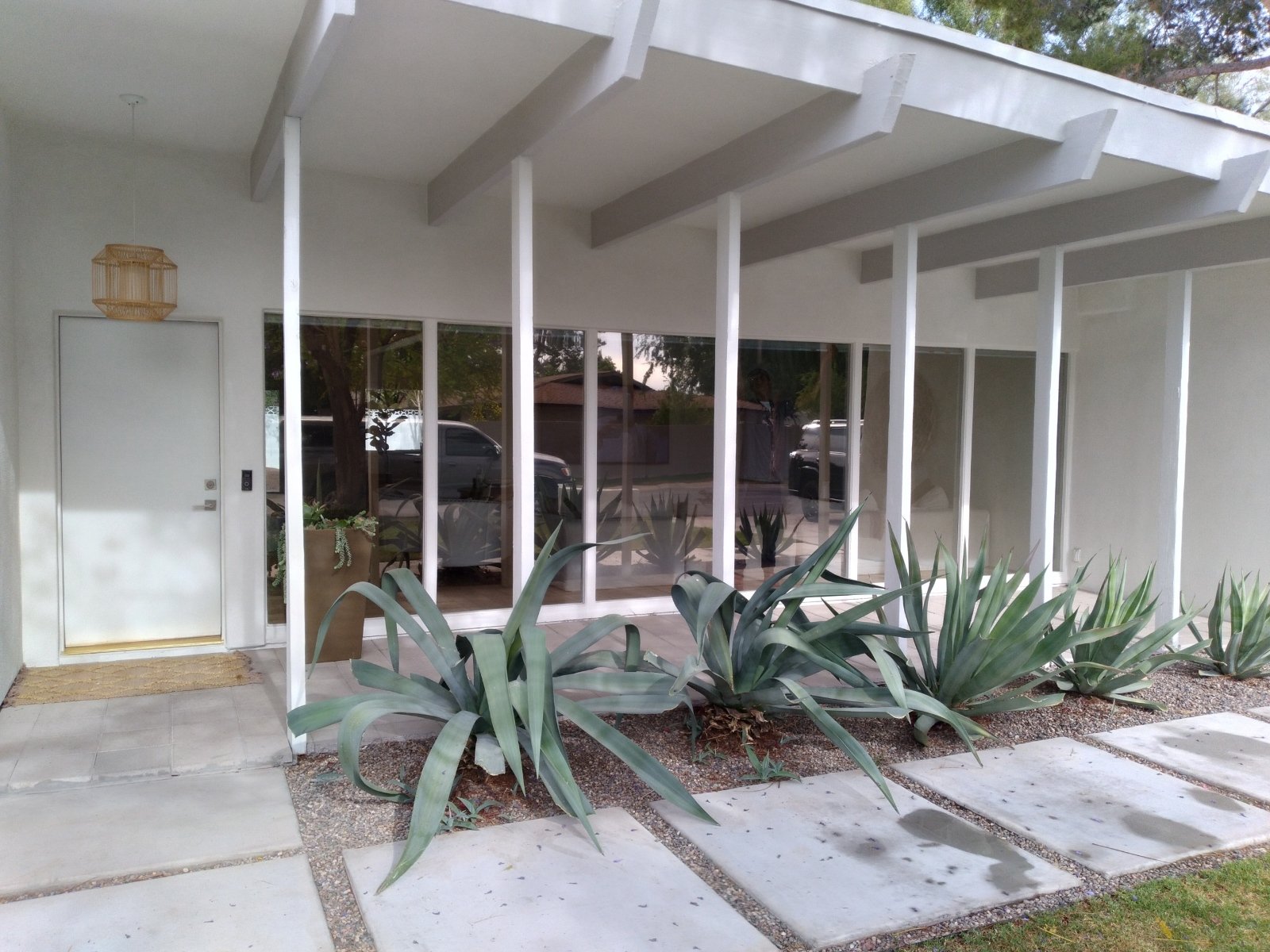
Here is one from our own work, the Arcadia home pictured at the top of this article. A homeowner in Arcadia, in Phoenix, had about 165 square feet of west-facing glass heating the house every afternoon, and an HOA that would not approve a reflective film. That ruled out the metal-based films, so we chose among low-reflectance options and installed XPEL Clear View Ceramic 35. On XPEL's spec sheet it rejects 61% of total solar energy with 16% exterior reflectance, where the metal-based Clear View Alloy 40 shows 33%. The appearance rule decided it, not the word ceramic.
How to choose window film by the numbers
- Total solar energy rejected (TSER) or SHGC: how much of the sun's heat stays outside. Our guide to solar heat gain coefficient window films explains how to read it.
- Visible light transmitted (VLT): how bright the room stays.
- Exterior reflectance: how mirrored the glass looks from outside. Our article on reflective window tinting in Arizona covers the look.
- Energy absorbed: how much heat the glass has to carry.
- The glass compatibility chart: whether the film is approved for your exact glass.
Compare those numbers only between films tested on the same glass. Values on 3 mm test glass and 6 mm test glass are not directly comparable.
The bottom line
For flat glass, there are many more options, and usually better ones, than the handful of films sold on the word ceramic. A properly chosen metal-based or spectrally selective film will usually reject more heat, put less stress on your glass and do a better job on the problem you actually have. If you are weighing film against replacing the glass, our comparison of solar window film vs Low-E glass covers that decision.
If you want film matched to your glass and your sun problem rather than a marketing trend, ask us for a quote. We will bring samples and the spec sheets, and show you the numbers on your own windows.
Frequently asked questions
Is ceramic window film good for homes?
It can work, but it is rarely the strongest choice for heat. On XPEL's own spec sheet, Clear View Ceramic 50 rejects 48% of solar energy while Clear View Alloy 50, at nearly the same light level, rejects 57% and absorbs less of that energy into the glass. Most homes in Arizona have dual-pane glass, so we choose film by its numbers and by the manufacturer's glass compatibility chart, not by the word on the box.
Why is ceramic film so popular if it is not the top performer?
The word caught on in car tint, where it came to mean premium, and it moved over to homes and buildings from there. The popularity comes from marketing, not from better results on flat glass. Some films are even labeled ceramic without containing any ceramic material.
Does ceramic window film reduce heat?
Yes, it reduces some heat. It does much of that by absorbing energy into the glass rather than reflecting it away. Reflective metal films at the same light level keep more energy off the glass, which you can see in the energy reflected and energy absorbed lines of a spec sheet.
What should I compare instead of the film type?
Compare total solar energy rejected (TSER) or the solar heat gain coefficient (SHGC), visible light transmitted (VLT), exterior reflectance, and the share of energy absorbed. Then check the manufacturer's glass compatibility chart for your exact glass. Those numbers decide how much heat stays out and whether the film is safe on your windows.
Do you still install ceramic film?
Yes. We install it where the numbers, the glass and the look the owner wants point to it, for example where a building already has weak cell reception and a metal film could make it worse. We just don't recommend it because of its name.