
Solar and Window Screens
Solar Screens for Windows
Solar screens for windows are exterior mesh panels that shade the glass before sunlight reaches it. We build them for Phoenix metro homes and businesses in Phifer SunTex 80, published at 80% of the sun's heat and glare blocked, or SunTex 90, at 90%, in six colors, measured and quoted in writing.
- Free on-site quotes
- Phifer screen fabrics
- Lifetime workmanship warranty
Overview
Solar screens for windows in the Phoenix metro
A solar screen is a tightly woven mesh panel that mounts on the outside of a window. Because it sits in front of the glass, it catches sunlight before it reaches the pane, which is the main reason exterior shading works so well on Arizona’s east, south and west walls. We build new solar screens for windows that have none, and we put new solar fabric into frames you already own through our window screen repair service.
We use two Phifer fabrics: SunTex 80 and SunTex 90. Both are vinyl-coated polyester, both come in the same six colors (Brown, Black, Grey, Stucco, Beige and Dark Bronze), and Phifer lists both with a 10-year exterior warranty. The difference is how open the weave is, and that one difference drives almost everything else. Every number on this page is Phifer’s published figure.
Part of our solar and window screen services across the Phoenix metro.
SunTex 80 vs 90
SunTex 80 vs SunTex 90 at a glance
Phifer publishes SunTex 80 as blocking 80% of the sun’s heat and glare and 75% of UV, with 25% openness. SunTex 90 blocks 90% of heat and glare and 90% of UV, with 10% openness. Openness is the share of the fabric that is open air between the yarns. More openness means more light, more airflow and a clearer view; less openness means more shade.
Phifer also publishes per-color performance with the fabric installed outside the glass. With 1/8 inch clear single glass, the numbers look like this:
SunTex 80
Visible light of 36% to 39%, and a solar heat gain coefficient (SHGC) of 0.30 to 0.33, depending on color.SunTex 90
Visible light of 18% to 20%, and an SHGC of 0.18 to 0.21, depending on color.
SHGC is the share of the sun’s heat that ends up inside, written as a decimal, so lower is cooler. On these figures, SunTex 90 lets in about two thirds of the solar heat SunTex 80 does, and about half the daylight.
On strength, Phifer publishes a breaking strength of 269 lb warp and 237 lb fill for SunTex 80, and 378 lb warp and 276 lb fill for SunTex 90, and describes both as pet resistant.
What openness means for the view
With 25% open area, SunTex 80 reads as a light tint over the view: you can see the yard, the street and faces clearly during the day. With 10% open area, SunTex 90 is closer to a shade you can see through. It works well on a window you mostly want dimmed, such as a media room or a bedroom that takes the evening sun. Both screens give daytime privacy, because the outside is brighter than the room. After dark, with lights on inside, that effect reverses.
Colors
Solar screen color: what Phifer’s numbers show
Color changes performance more than people expect, and not always in the direction they guess.
For SunTex 80 on 1/8 inch clear glass, Phifer lists Brown and Black at 37% visible light and an SHGC of 0.32, Dark Bronze at 38% and 0.32, Grey at 36% and 0.30, Stucco at 36% and 0.31, and Beige at 39% and 0.33. For SunTex 90, Brown and Dark Bronze are at 18% and 0.20, Black at 19% and 0.21, Grey at 18% and 0.18, Stucco at 20% and 0.20, and Beige at 20% and 0.20.
The lighter colors reflect more sunlight off the mesh, while the dark colors absorb it. That is why Grey posts the lowest SHGC in both fabrics. The spread between colors is small, though: a few hundredths of SHGC within each fabric.
Dark colors for the clearest view out
Phifer’s guidance is plain: “Dark colors provide maximum glare reduction and visibility.” A dark mesh absorbs the light that hits it instead of bouncing it back toward your eyes, so the view through it looks sharper and less washed out. If you sit by the window and look out, Black, Brown or Dark Bronze is usually the better choice.
Lighter colors to match stucco
Stucco and Beige blend into tan or cream walls and can make screens less noticeable from the street. Many HOAs review exterior screen colors, so check your community’s rules before choosing. It helps to hold a color sample against your wall and look through it from inside before you decide.
Phifer SunTex durability and certifications
Phifer lists the same certifications for both SunTex fabrics. They carry a Class A rating under NFPA 101 and IBC Section 803.1.1 for fire, GREENGUARD Gold certification for low chemical emissions, and Microban antimicrobial additives tested to ASTM standards for bacteria and fungal resistance. Phifer describes SunTex 90 as pet resistant, able to withstand claws and paws from household critters. None of that makes a screen indestructible: the frame, how often the panel is handled and how much sun it takes all affect how long it looks good.
Exterior solar screens and the SRP shade screen rebate
SRP’s residential Shade Screen and Window Film Rebate Program sets three conditions for screens: they must block at least 80% of solar heat gain, go on sunstruck windows, and be mounted on the exterior. Phifer publishes SunTex 80 at 80% and SunTex 90 at 90%, so both meet the blocking figure on paper. SRP decides eligibility, not us, so confirm with SRP at savewithsrp.com before buying. Our SRP rebate page and the article on SRP sunscreen rebates cover the program in more detail. We do not know of a screen rebate from APS; APS customers should check aps.com.
When window film beats sun screens for windows
A screen is always in front of the view, and even SunTex 80 cuts visible light to under 40% on Phifer’s figures. For a family room slider, a wall of glass facing the mountains, or a picture window over the pool, most owners would rather keep the glass clear. That is where solar window film earns its place: it goes on the inside of the glass, leaves the exterior unchanged, and never needs to come down for cleaning. If faded floors are the main worry, UV protection window film blocks UV without darkening the room.
Screens make sense on side windows, garage windows, and walls where the view is a fence. Many homes end up with both. Our guide to solar screens vs window film in Arizona compares the two in detail, and the window screens overview covers our other screen services.
Shade screens for businesses and common areas
Offices, restaurants, and HOA or multifamily clubhouses use shade screens on secondary windows that take hard afternoon sun. Storefronts and lobbies are different: the glass is how customers see in, so commercial window tinting is usually the better tool there.
Projects
Solar Screens projects
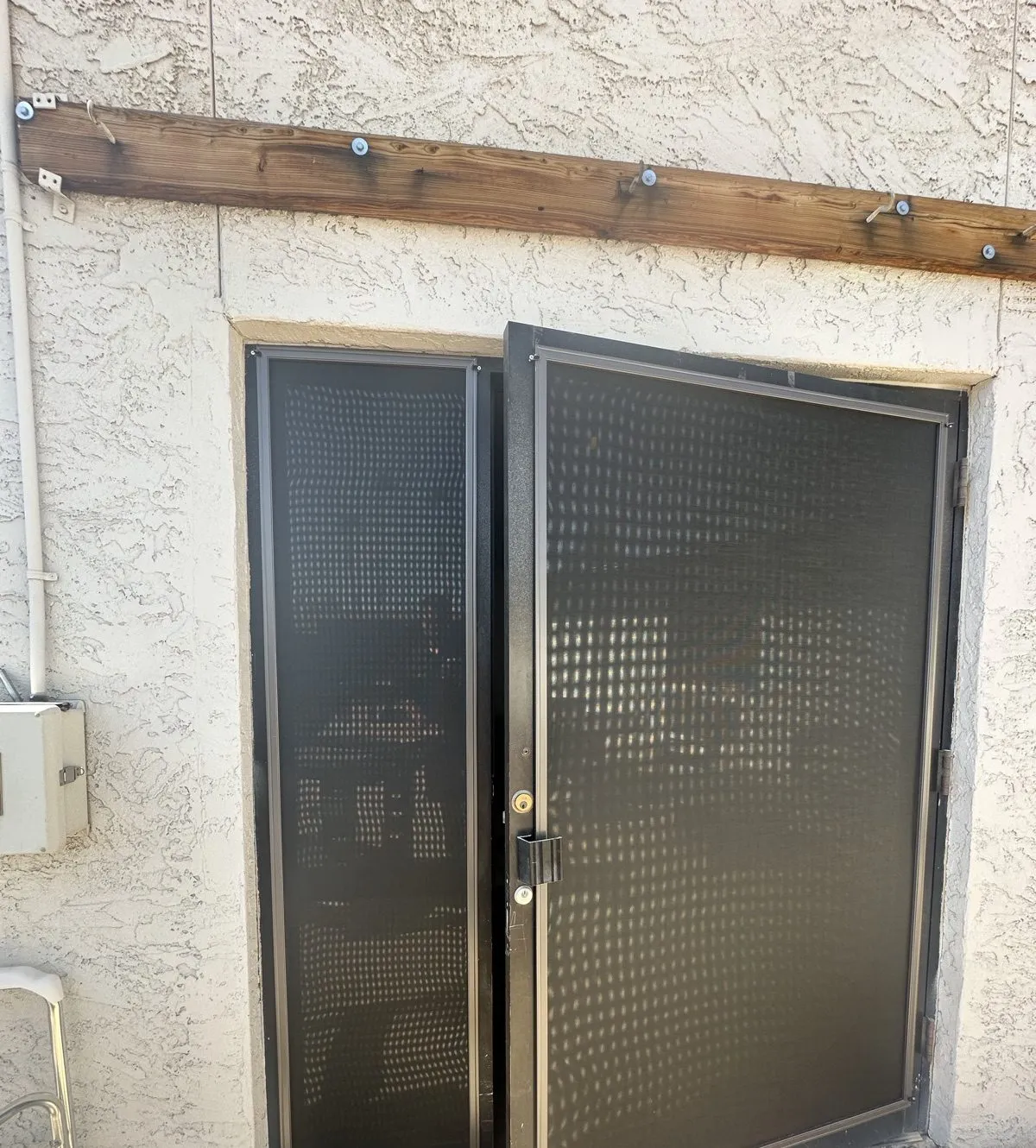
Solar screens in Tempe, AZ
Desert Marigold Senior Living: solar screens and lobby film
Tempe · Solar Screens · Solar Window Film ·
Phifer SunTex 90 solar screens on the doors of the memory care unit, combined with Madico Optivision Reflective 5 window film to cut heat in the lobby.
What's included
Every screen job includes
Free on-site quote
We bring the Phifer fabrics and frame colors to your home or building so you can compare them on your own windows.
Rust-proof aluminum frames
Bronze, Champagne, Almond or White.
Phifer screen fabrics
SunTex 80 and 90 solar screens, Phiferglass insect screen and PetScreen.
Lifetime workmanship warranty
Covers workmanship and installation defects, backed by our Arizona ROC license #333727.
Cost
Solar screens cost and how we quote
Screen quotes are free, and we do not publish screen prices. A quote depends on how many openings need screens, their sizes, the fabric and color, and whether each window needs a new frame or only new fabric. The crew measures every opening, each new screen is built to fit its opening, and you get a written quote listing every screen before work is scheduled. We bring the SunTex fabrics and the frame colors to the visit, so you can compare them on your own windows. New frames are rust-proof aluminum in Bronze, Champagne, Almond or White. Our own work carries a lifetime warranty against workmanship and installation defects, backed by our Arizona ROC license. To arrange a visit, use the form below or contact us.
More services
More screen services
Service areas
Solar Screens by city
Should I choose SunTex 80 or SunTex 90 for a west window?
If the window has no view worth keeping and takes hard afternoon sun, SunTex 90 does more: Phifer publishes it at 90% of heat and glare blocked against 80% for SunTex 80. If you still want to see out comfortably, SunTex 80 lets through roughly twice the visible light.
Which SunTex color gives the clearest view out?
Phifer says dark colors provide maximum glare reduction and visibility. Black, Brown and Dark Bronze absorb most of the light that hits the mesh instead of reflecting it back at you, so the outdoors reads more clearly through them than through Stucco or Beige.
Do solar screens make rooms dark during the day?
Somewhat. Phifer publishes visible light through SunTex 80 at 36% to 39% depending on color, and SunTex 90 at 18% to 20%, measured with the fabric outside 1/8 inch clear glass. Most owners pick SunTex 80 for rooms they use in daylight.
Do SunTex 80 and SunTex 90 meet SRP's 80% shade screen rule?
Phifer publishes SunTex 80 at 80% and SunTex 90 at 90% of the sun's heat blocked, so both meet the figure on paper. SRP sets the rules and decides eligibility, so confirm with SRP at savewithsrp.com before you buy screens for a rebate.
What warranty comes with SunTex solar screens?
Two layers. Phifer lists a 10-year exterior warranty for SunTex 80 and SunTex 90 fabric. On top of that, our installation carries a lifetime warranty against workmanship and installation defects, backed by our Arizona ROC license.
How much do solar screens cost in the Phoenix metro?
We do not publish a per-window price. The cost depends on how many openings you have, their sizes, SunTex 80 or 90, and whether frames are new. The crew measures each opening and you receive a written quote that lists every screen.
Free consultation
Book a free screen consultation
Tell us about your windows and doors and we'll send a written quote.
(480) 977-6994- Arizona: ROC Lic# 333727
Licensed, factory-authorized window film installers
- Arizona: ROC Lic# 333727
- Solar Gard / Saint-Gobain authorized dealer
- Armorcoat authorized installer
- XPEL authorized dealer
- Madico SafetyShield qualified dealer
- Full XPEL VISION line installed
- 25 years of window film experience
Because we're factory-authorized, film is installed to manufacturer spec and carries the manufacturer's warranty.