
Commercial Window Tinting
One-Way Window Film for Offices and Storefronts
One-way window film is a reflective film that lets people inside see out while people outside see a mirror, as long as the outside is brighter than the inside. It suits street-facing offices and storefronts during business hours. It reverses at night when interior lights are on. Installed rates start at $8.25 per square foot.
- From $8.25 per sq ft installed
- After-hours or weekend installs
- Daytime one-way privacy
Overview
How one-way window film works
“One-way” is the common name, but the film does not have a direction built into it. It is a metallized film with a high reflectance. Whichever side of the glass is brighter sees a reflection, and whichever side is darker sees through.
On a sunny Arizona afternoon, the street is much brighter than an office. People walking by see a mirrored window, and staff inside see out to the parking lot or street. That is the effect most businesses are after: daytime privacy for desks and screens without blinds that shut out the view.
We are direct about the limits because they decide whether this film is the right one for your space. It is part of the commercial window tinting we install, and we recommend it only where the light conditions support it.
Part of our commercial window tinting services.
At night
Does one-way window film work at night?
When the sun goes down and the interior lights come on, the brightness flips. Now the office is the brighter side, so people outside can see in and people inside see their own reflection in the glass. The film is working exactly the same way; the light has changed.
This matters for:
Offices that stay open in the evening
Accounting firms in tax season, property management offices, and any suite with late shifts.Storefronts that light displays after hours
The film will not hide a lit interior at night.Medical and dental suites with evening appointments
Exam rooms should not rely on reflective film alone for privacy.
There are practical ways around it. Blinds or shades can close at dusk. Interior lighting can be placed away from the glass. For rooms that need privacy at every hour, a frosted film or a combination of a reflective film on the upper glass and frost on the lower glass often works better. Our commercial privacy window film page compares those options.
Where it's used
One-way privacy film for offices and storefronts
Ground-floor offices on busy streets
Desks along the glass stay private during business hours.Banks, credit unions and professional offices
Teller and consultation areas that face a sidewalk or parking lot.Reception areas
Staff can see who is approaching the entry while the lobby interior is screened.Upper-floor offices facing a neighboring building
Where the next building looks straight into yours.Security and observation rooms
Spaces kept dimmer than the area they overlook, which is the setup where reflective film performs most consistently.
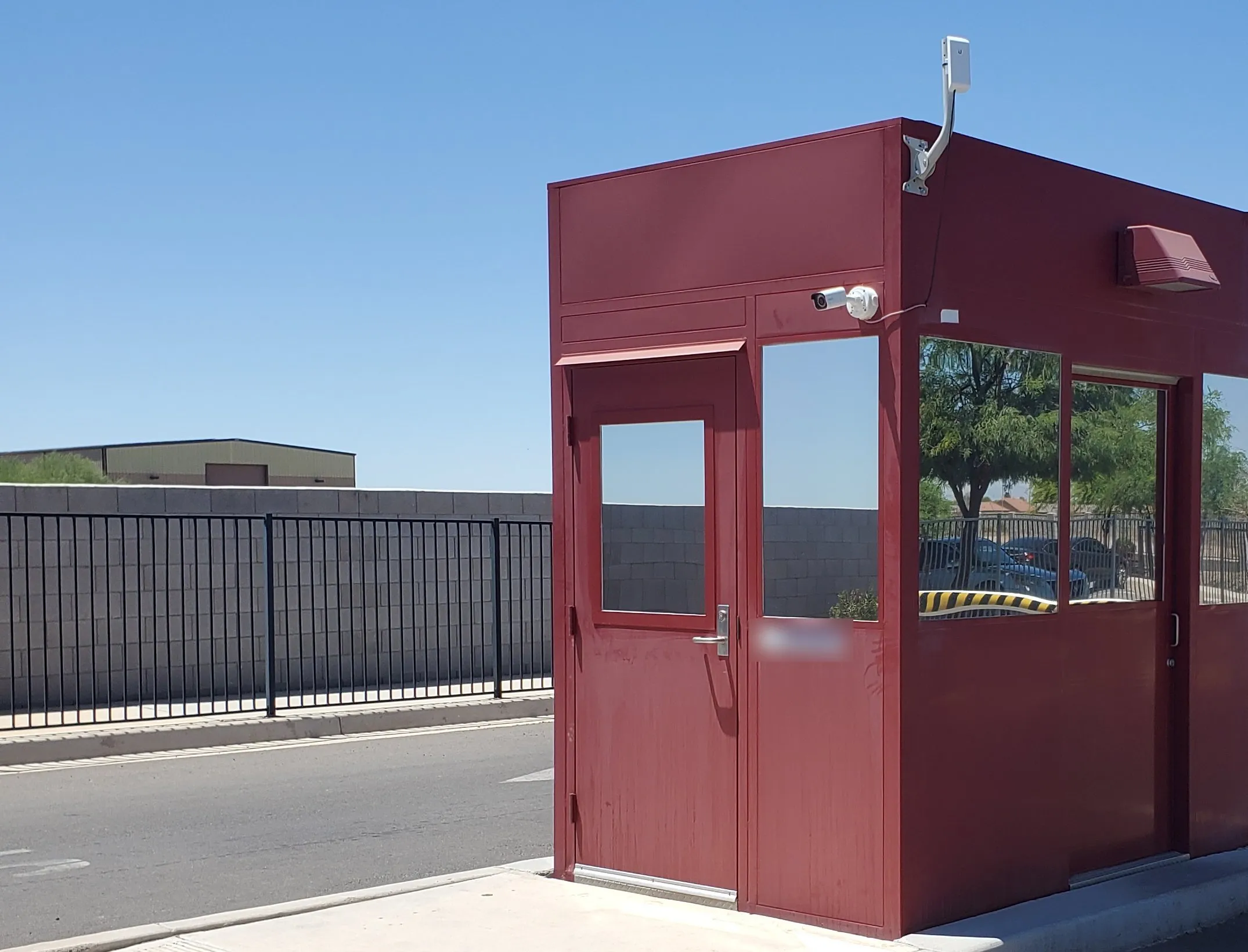
In July 2022 we put one-way film on the security checkpoint booth at the entrance of an industrial plant in Casa Grande. The guards inside can watch the gate and the approach road, while in daylight drivers pulling up see the trees and parking lot mirrored in the glass instead of the people and equipment inside the booth.
Comparing films
One-way mirror film: comparing reflectance and darkness
The two numbers to look at are exterior visible light reflectance, which drives the mirror effect, and visible light transmission, which tells you how much daylight still reaches the room. XPEL publishes both for its metallic films on 3 mm glass:
XPEL Blend DR 17
45% exterior reflectance, 13% visible light transmission.XPEL Evening View 15
49% exterior reflectance, 15% visible light transmission.XPEL Silver 15
58% exterior reflectance, 17% visible light transmission.XPEL Evening View 5
57% exterior reflectance, 8% visible light transmission.
A higher reflectance number gives a stronger mirror during the day. A lower transmission number makes the room darker and, at night, makes the interior a little harder to see into, though it will not stop it. These films also cut a great deal of solar heat. XPEL lists Silver 15 at a 0.22 solar heat gain coefficient on 3 mm glass, which is useful on west-facing storefronts. For heat control without the mirrored look, see our commercial solar window film page.
Specs
Commercial one-way window film specs
XPEL
| Film | Visible light transmitted | Total solar energy rejected | SHGC | UV blocked | Glare reduction |
|---|---|---|---|---|---|
| Evening View 15SRP rebate eligible | 15% | 76% | 0.24 | 99% | 83% |
| Evening View 5SRP rebate eligible | 8% | 81% | 0.19 | 99% | 92% |
| Exterior Silver 15 | 18% | 78% | 0.22 | 99% | 81% |
| Silver 15 | 17% | 78% | 0.22 | 99% | 82% |
| Blend DR 17 | 13% | 79% | 0.21 | 99% | 87% |
| Exterior Blend DR 7 | 5% | 88% | 0.12 | 99% | 95% |
Manufacturer-published values measured on 1/8" (3 mm) glass; results on your windows vary by glass type. Sources: spec sheet
Interior or exterior reflective film
Most one-way film goes on the inside of the glass. XPEL also makes exterior versions, applied to the outside surface, for glass where an interior film is not a good match. XPEL lists Exterior Silver 15 at 59% exterior reflectance and 18% visible light transmission, and Exterior Blend DR 7 at 64% exterior reflectance and 5% visible light transmission, both on 3 mm glass.
During the site survey we check the glass type, the frames and the condition of each pane, and recommend interior or exterior film based on what the glass can take. Exterior work on upper floors may need a lift, which adds 15% to the price.
Day and night privacy: reflective film with frost
Many offices get the best result from two films on the same glass line. Reflective film on the upper glass keeps the view out and cuts heat and glare during the day. A frosted band across the lower glass, at seated eye level, screens desks and screens at every hour, including after dark when the reflective film no longer hides the room. The combination costs a little more than a single film, but it removes the main weakness of one-way film without giving up the view. Our frosted window film page covers the frost options.
Questions we ask before recommending it
One-way film works well when the conditions are right and disappoints when they are not. Before we put it in a proposal, we ask:
What hours does the space need privacy?
If the answer includes evenings with the lights on, reflective film alone will not do it.Which way does the glass face?
An elevation in deep shade all day may not be bright enough outside to produce a strong mirror.How bright is the interior?
Rooms with strong lighting near the glass weaken the effect even during the day.Who needs to see whom?
Reception desks often want to see out to the entry, which suits reflective film. Exam rooms and restrooms need privacy in both directions, which does not.Are there appearance rules?
Some leases and associations limit mirrored glass on the exterior.
If the answers point away from reflective film, we will say so and suggest a better fit. Our commercial anti-glare window film page covers lower-reflectance films for glass where glare, not privacy, is the main problem.
Installation for businesses that stay open
We schedule around your hours. Interior film can be installed with staff working nearby, and after-hours or weekend installs are available for storefronts and customer-facing suites. The crew protects the area along the glass, applies and trims the film, and cleans up before leaving. The film needs time to cure afterward, and a light haze is normal while moisture dries out.
Cost
What reflective privacy film costs
Installed rates for one-way film start at $8.25 per square foot. The total depends on square footage, the film, interior or exterior application, old film removal (which adds $4.50 per square foot) and access. Every project gets a written proposal with the published data for the film we recommend. For commercial buildings, XPEL warrants Silver films for 15 years, Evening View and Blend DR for 10 years, and exterior films for 5 years on the film and 2 years on labor, all requiring an authorized dealer install. If you are weighing a single reflective film against a reflective and frost combination, we can price both so you can compare the cost against the hours of privacy each one gives you. Warranty terms are set by the manufacturer and vary by film; the proposal lists the coverage for each product, and our window film warranty page explains how manufacturer coverage works.
Commercial one-way window film cost per square foot
Installed prices start at $8.25 per square foot. Your written proposal is based on measured glass, film choice and access.
Commercial one-way window film projects
One-way window film in Casa Grande, AZ
Security checkpoint one-way film
Casa Grande, AZ · One-Way Window Film ·
One-way film on the guard booth at an industrial plant entrance: guards see the gate and approach road, and in daylight drivers see a mirror.
Related films
More commercial window tinting films
Guides
Commercial one-way window film guides
Is there a window film that you can see out but no one can see in?
Yes, with one condition. Reflective films such as XPEL Silver 15 give a view out and a mirrored look from outside while the outside is brighter than the room. When that reverses, so does the effect.
Does one way window film work at night?
Not when the lights are on inside. After dark the interior is the brighter side, so people outside can see in and people inside see their own reflection. Offices that stay lit in the evening usually pair the film with blinds or shades.
What is the best one-way window film?
There is no single right answer; it depends on how much daytime privacy you need and how dark you can let the room get. Higher reflectance gives a stronger mirror effect. XPEL Exterior Blend DR 7 reflects 64% and passes 5% of visible light on 3 mm glass, while Blend DR 17 reflects 45% and passes 13%.
What can you put on a window so you can see out but not in?
A reflective one-way film is the usual answer for daytime use. If you need privacy at all hours and can give up the view, frosted window film blocks sight lines in both directions.
Does one-way film change how the building looks from the street?
Yes. That mirrored look is how the film works. If your landlord or association limits reflective glass, check before you choose this film, and we can provide spec sheets for their review.
Can one-way film go on interior glass between two rooms?
It can, but it only works if one room is consistently brighter than the other. For glass between two lit offices, frost or a decorative film is usually more reliable.
Free consultation
Book a free window tinting consultation
Tell us about your glass and we'll send a written proposal.
(480) 977-6994- Arizona: ROC Lic# 333727
Licensed, factory-authorized window film installers
- Arizona: ROC Lic# 333727
- Solar Gard / Saint-Gobain authorized dealer
- Armorcoat authorized installer
- XPEL authorized dealer
- Madico SafetyShield qualified dealer
- Full XPEL VISION line installed
- 25 years of window film experience
Because we're factory-authorized, film is installed to manufacturer spec and carries the manufacturer's warranty.