
Home Window Tinting
Solar Window Film for Homes
Solar window film for homes is a thin film applied to your existing glass that rejects part of the sun's heat before it reaches the room. We fit it to glass walls, view windows and sliders across Arizona, often in low-reflectance shades that barely change the exterior, from $8.25 per square foot.
- From $8.25 per sq ft installed
- Most homes finished in a day
- Samples for HOA and design review
Overview
Solar window film for homes with glass walls
Homes designed around a view tend to have a lot of glass: a great room that opens to the pool through a wall of sliders, a master suite with floor-to-ceiling windows, clerestories that pull light deep into the house. That glass is the reason the house feels the way it does. It is also where most of the summer heat gets in, and where sunlight lands on wood floors, upholstery and art for hours each afternoon.
Solar window film addresses that without changing the architecture. It is applied to the glass you already have, so frames, pocket doors and sightlines stay exactly as designed. The film reflects or absorbs a share of the sun’s infrared and visible energy and blocks ultraviolet light, which changes how a room feels when the sun is on that elevation.
Part of our home window tinting services; also available as solar window film for commercial buildings.
Spec sheet
Reading a solar control window film spec sheet
Four published numbers matter most for a home with large glass:
Total solar energy rejected (TSER)
The share of the sun’s total energy kept out. Higher is cooler.Solar heat gain coefficient (SHGC)
The share of solar heat that gets through, as a decimal. Lower is cooler, and SRP uses it for its rebate.Visible light transmission (VLT)
How much daylight comes through. Higher means a brighter room and a clearer view.Exterior reflectance
How much light the glass bounces back toward the street or the yard. Lower means the house looks more like it did before.
Solar Gard tests on 6 mm clear glass and XPEL on 3 mm glass, so their figures are not a direct comparison. We compare within a brand, or hold samples of both against your windows.
Specs
Solar window film specs
Solar Gard TrueVue
SRP rebate eligible| Film | Visible light transmitted | Total solar energy rejected | SHGC | UV blocked | Glare reduction |
|---|---|---|---|---|---|
| TrueVue 30 | 31% | 61% | 0.39 | >99% | n/a |
| TrueVue 15 | 12% | 77% | 0.23 | >99% | n/a |
| TrueVue 5 | 5% | 79% | 0.21 | >99% | n/a |
Manufacturer-published values measured on 1/4" (6 mm) clear glass; results on your windows vary by glass type. Sources: spec sheet
XPEL Evening View
SRP rebate eligible| Film | Visible light transmitted | Total solar energy rejected | SHGC | UV blocked | Glare reduction |
|---|---|---|---|---|---|
| Evening View 25 | 26% | 61% | 0.39 | 99% | 69% |
| Evening View 15 | 15% | 76% | 0.24 | 99% | 83% |
| Evening View 5 | 8% | 81% | 0.19 | 99% | 92% |
Manufacturer-published values measured on 1/8" (3 mm) glass; results on your windows vary by glass type. Sources: spec sheet
Film types
Low-reflectance solar film for a quiet facade
An architect chose the glass for a reason, and a mirrored or tinted look would undo that. Low-reflectance films are made for this.
Solar Gard publishes Panorama HiLite 70 at 70% visible light and 54% total solar energy rejected on 6 mm clear glass, with 8% exterior reflectance. Panorama HiLite 40 keeps 40% of visible light, rejects 61% and reflects 6%. Panorama HiLite 25 keeps 21%, rejects 65% and reflects just 5%. Across the series the outside of the glass stays close to untreated, even as the shade deepens.
XPEL’s Clear View Plus series follows a similar idea on its 3 mm test glass. Clear View Plus 70 keeps 72% of visible light with 55% of solar energy rejected and 8% exterior reflectance. Clear View Plus 40 keeps 40% with 62% rejected and 6% reflectance. Maxpro Elite Max 70 is another clear option we install.
Tinted solar film for rooms that need more
Some rooms need stronger heat control than a near-invisible film provides: a west-facing living room with no overhang, a home theater, a guest suite that has to stay dim in the afternoon.
Solar Gard TrueVue 30 is published at 31% visible light and 61% total solar energy rejected on 6 mm clear glass, with an SHGC of 0.39. On its own 3 mm test glass, XPEL publishes Evening View 25 at 26% visible light and an SHGC of 0.39. At the dark end, Solar Gard TrueVue 5 is published at 5% visible light and 79% rejected on 6 mm clear glass, and XPEL Evening View 5 at 8% visible light and 81% rejected on 3 mm glass. These darker metallic films are more reflective from outside, which is worth weighing against review guidelines and the look of the elevation.
Some glass is better served by film on the outside. XPEL Exterior Clear Performance 75 is made for exterior application and keeps 78% visible light on 3 mm glass. Our article on exterior window tint explains that approach.
Room by room
A solar film plan, room by room
We rarely put one film on every window of a house. A typical recommendation for a home with a lot of glass looks like this:
Great rooms and glass walls facing west or south
A low-reflectance film in the 40 to 55 range, or a moderate film where the sun is relentless.Primary suites
A deeper shade where afternoon or early light reaches the bed.Home theaters and media rooms
A dark film, often paired with shades.Offices and studies
A film that takes the glare off a monitor without dulling the room. See anti-glare window film for more.Sliders and pocket doors facing the pool
Large panes that take light reflected off the water as well as direct sun.Clerestories and high glass
Hard to shade any other way, and often the source of a hot spot on the floor below.
If keeping light high is the priority and protecting floors, rugs and art is the real concern, UV protection window film may be all a room needs.
Dual-pane glass, low-E glass and design review
Before recommending a film we look at each window: single-pane or dual-pane, tempered or annealed, and whether there is a factory low-E coating. Some dual-pane and low-E units limit which films can safely go on the inside, because a film that absorbs too much heat at the glass can stress the unit. That is why the proposal names a film for each window.
Homeowners associations and architects usually care about how the house reads from outside. Low-reflectance films such as the Panorama HiLite series are the easiest to present for review. We can provide product data for a submission and leave samples so you, your designer or the committee can judge them from the yard and the street.
Solar window film installation day
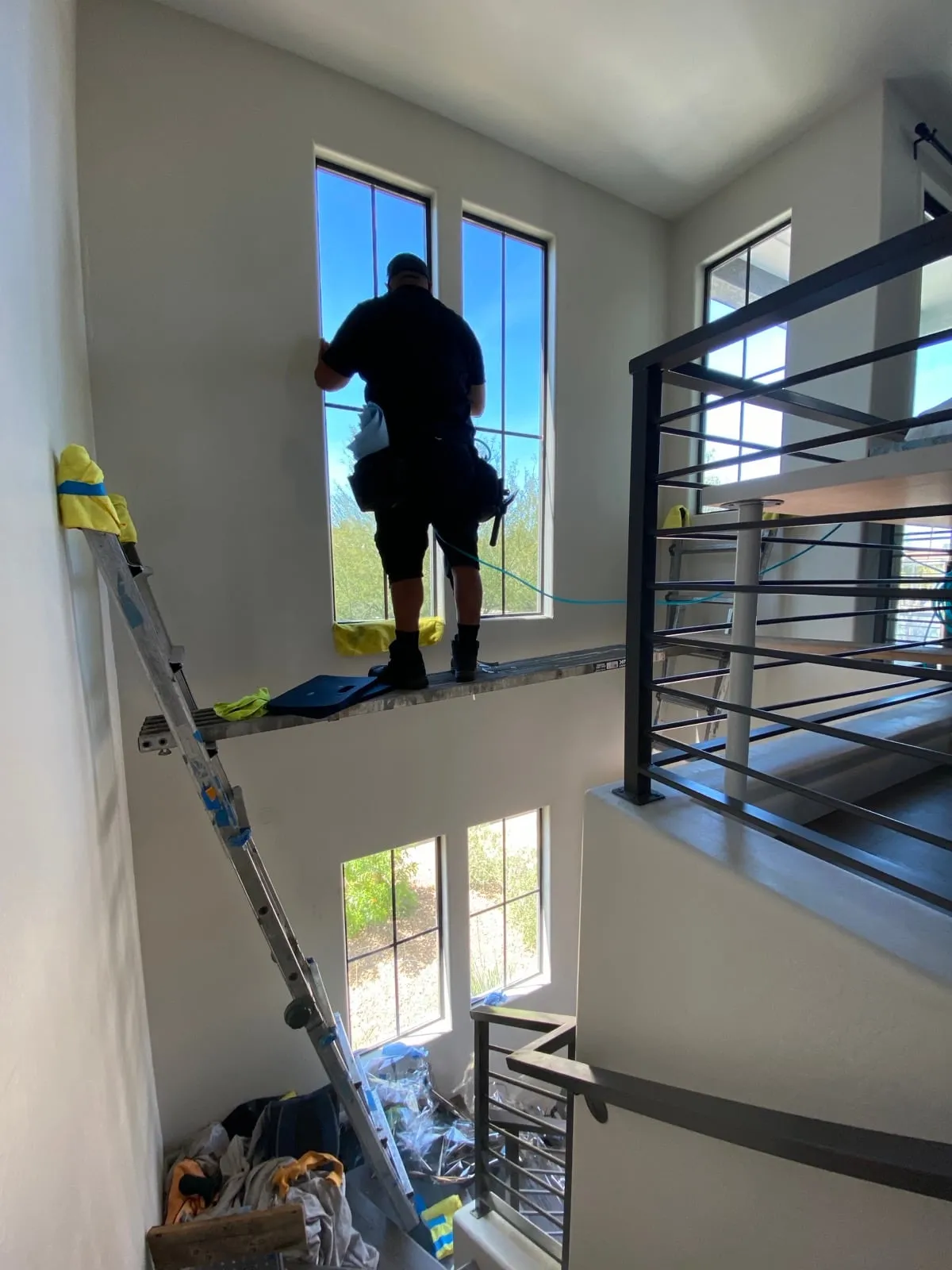
Most homes are finished in a day. The crew covers floors and sills, moves or wraps furniture near the glass, cleans each pane, cuts film to the glass and squeegees out the water underneath. You may see small water pockets or a slight haze at first, which usually clears in a few days. Solar Gard’s care guidance is to wait 30 days before the first cleaning, then use mild dish soap, water and a soft cloth. If a window cleaning service looks after the house, we will give you a copy of the care instructions to pass along.
Solar film is one part of what we do for homes. The home window tinting page covers the full range, and for offices and retail buildings, see commercial solar window film.
Cost
What solar film costs per square foot
Residential solar control film starts from $8.25 per square foot. Clear ceramic films start from $9.00 per square foot, and darker ceramic films from $11.50. Removing old, failing film adds $4.50 per square foot, and second-story or lift access adds 15%, which applies to most clerestory and two-story glass. The written proposal lists the film, the square footage of each window and the total.
Solar Gard TrueVue, XPEL Clear View and XPEL Evening View each carry a Limited Lifetime residential warranty from the manufacturer, and XPEL exterior films carry 5 years on the film and 2 years on labor. Coverage requires an authorized dealer install, and our window film warranty page explains how it works.
Solar window film cost per square foot
Installed prices start at $8.25 per square foot. Your written proposal is based on measured glass, film choice and access.
| Film grade | Installed price per sq ft |
|---|---|
| Clear ceramic | From $9.00 |
| Darker ceramic | From $11.50 |
| Solar control | From $8.25 |
Prices as of October 2026, from our bid-tool customer rates. Old film removal adds $4.50 per sq ft; upper-floor or lift access adds 15%.
SRP rebate
Solar film and the SRP window film rebate
SRP is the only Arizona utility with a window film rebate; APS and TEP do not currently offer one. SRP residential customers can get a rebate for new NFRC-certified film on east-, south- and west-facing windows of an air-conditioned home. The film must have a maximum SHGC of 0.45 on double-pane glass or 0.40 on single-pane glass, and it must be installed by an ROC-licensed contractor or by the homeowner. We are licensed as ROC #333727. Films we install that qualify include Solar Gard TrueVue 30, 15 and 5 and XPEL Evening View 25, 15 and 5.
You can apply within six months with a dated, paid invoice, or release the rebate to us and we take it off your invoice. Current amounts are at savewithsrp.com, and our SRP rebate guide walks through the steps.
Related films
More home window tinting films
Guides
Solar window film guides
What type of window film blocks the most sun heat?
Darker metallic and multi-layer films reject the most solar energy. XPEL publishes Evening View 5 at 81% total solar energy rejected on 3 mm glass, and Solar Gard publishes TrueVue 5 at 79% on 6 mm clear glass. If you want to keep the view, a spectrally selective film gives up some heat rejection to stay nearly clear.
Will solar film make my rooms darker?
That depends on the film. XPEL Clear View Plus 70 keeps 72% of visible light on 3 mm glass, so most people notice less glare rather than a darker room. Mid and dark shades trade daylight for more heat rejection.
Can solar film go on dual-pane windows?
Usually, yes, but not every film suits every unit. We identify the glass type and any factory low-E coating on each window, then recommend a film that is appropriate for that glass.
Can solar film keep a view window looking untreated from outside?
Often, yes. Solar Gard publishes the Panorama HiLite series at 5% to 8% exterior reflectance on 6 mm clear glass, and XPEL publishes Clear View Plus 70 at 8% on 3 mm glass, so the facade reads much like ordinary glass.
Will my HOA allow solar window film?
Most HOAs care about how the glass looks from the street. Low-reflectance films look close to untreated glass, and we can supply samples and product details for an architectural review submission.
Which solar films qualify for the SRP rebate?
Films we install that qualify include Solar Gard TrueVue 30, 15 and 5 and XPEL Evening View 25, 15 and 5. Current rebate amounts are published at savewithsrp.com, and our SRP rebate guide covers the rules.
How do you protect floors and furnishings during a solar film install?
The crew covers floors and sills, moves or wraps furniture near the glass, and works from the inside of each pane with water and squeegees. Most homes are finished in a day, and the written proposal notes anything that needs extra time.
Free consultation
Book a free window tinting consultation
Tell us about your glass and we'll send a written proposal.
(480) 977-6994- Arizona: ROC Lic# 333727
Licensed, factory-authorized window film installers
- Arizona: ROC Lic# 333727
- Solar Gard / Saint-Gobain authorized dealer
- Armorcoat authorized installer
- XPEL authorized dealer
- Madico SafetyShield qualified dealer
- Full XPEL VISION line installed
- 25 years of window film experience
Because we're factory-authorized, film is installed to manufacturer spec and carries the manufacturer's warranty.