
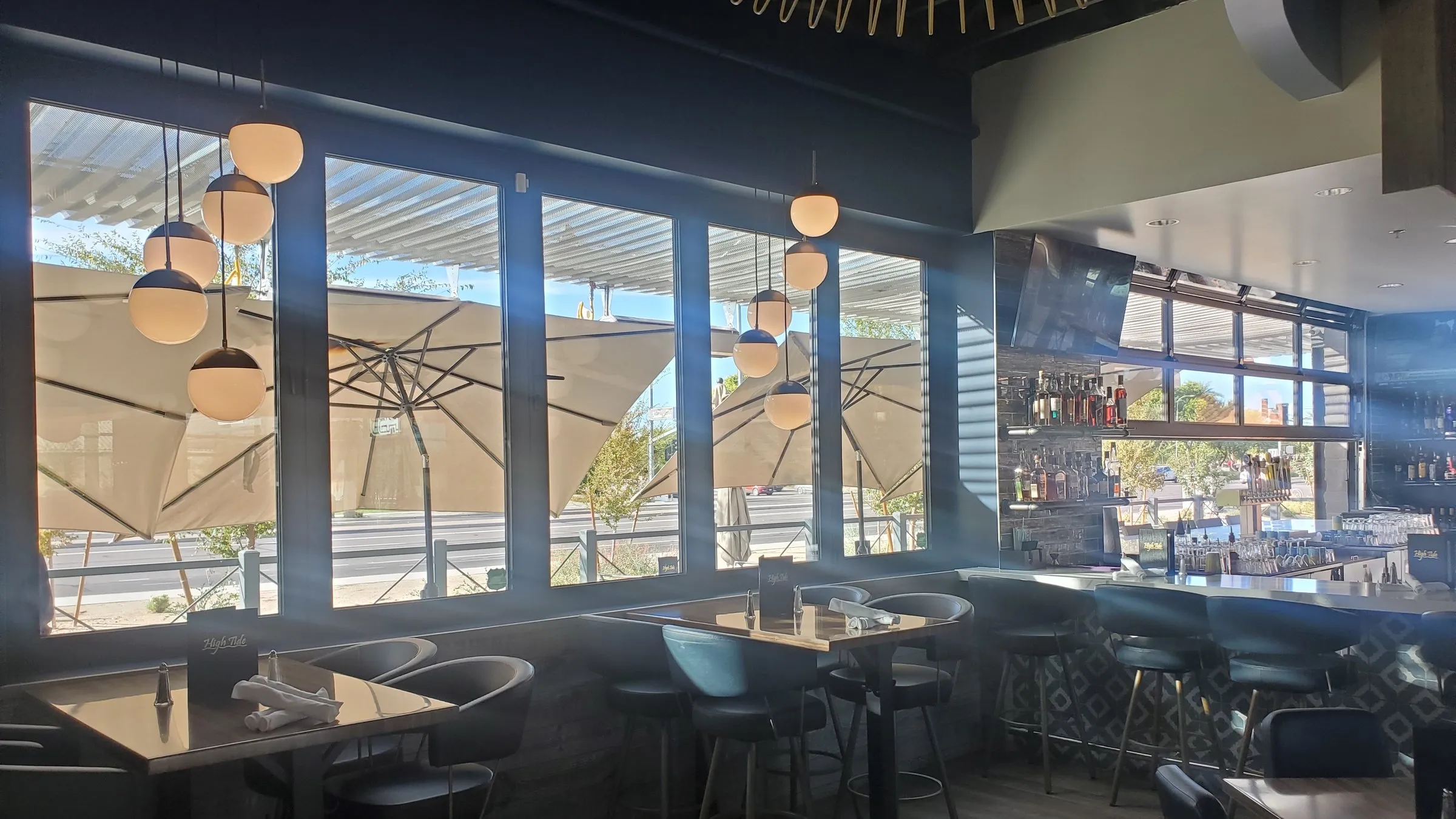
Commercial Window Tinting
Commercial Anti-Glare Window Film
Commercial anti-glare window film is a tinted architectural film applied to office, school and lobby glass to cut the bright sunlight that washes out screens and makes perimeter workspaces hard to use. We install it across Arizona around tenant schedules, with installed rates starting at $8.25 per square foot.
- From $8.25 per sq ft installed
- After-hours installs
- Samples you can test against a screen
Overview
Commercial anti-glare window film for perimeter offices
Ask a facilities team which desks sit empty on a sunny afternoon and the answer is usually the ones next to the glass. Low sun across a west or south elevation turns monitors into mirrors, forces people to close blinds, and pushes meetings out of the rooms with the best views. The building still pays to light, cool and lease that perimeter space, but tenants stop using it the way it was designed.
Anti-glare window film is a direct fix. It is a thin tinted polyester film applied to the inside of the existing glass, and it reduces the amount of visible light that reaches the room. Less incoming light means less contrast between the bright window and the screen, so people can work facing the glass or sitting beside it.
Blinds and shades solve the same problem by blocking the window entirely, which costs the room its daylight and view. They also tend to stay closed once someone lowers them, so a floor ends up lit by fixtures at midday. Film works full time without anyone touching it, and the view out stays intact. It is part of the full range of commercial window tinting we install for Arizona property managers, business owners and general contractors.
Where it pays off
Where office window film for glare pays off
Glare problems follow the sun, but they also follow how a space is used. The calls we get most often fall into a few groups:
Open offices and perimeter desks
Rows of monitors facing or beside full-height glass.Conference and training rooms
Wall-mounted displays and projector screens that wash out during afternoon meetings.Schools and universities
Classrooms with interactive boards, computer labs and administrative offices.Medical and dental suites
Reception areas and treatment rooms where staff read monitors all day and patients sit facing the window.Lobbies and atriums
Security desks and reception counters that face a glass wall, where the person behind the desk looks straight into the sun.Control rooms and dispatch centers
Spaces where screens are watched constantly and a blind is not a practical answer.
In each case the goal is the same: bring the brightness at the glass down to a level the room can work with, without giving up the view or the daylight.
Measuring glare
How anti-glare window film performance is measured
Two numbers matter most when comparing films. Visible light transmission (VLT) is the share of daylight that passes through the glass and film. Glare reduction describes how much less visible light reaches the room compared with untreated glass.
XPEL publishes both for its Evening View line, measured on 3 mm glass. Evening View 45 keeps 46% of visible light with 50% glare reduction. Evening View 25 keeps 26% of visible light with 69% glare reduction, and Evening View 5 brings that down to 8% visible light with 92% glare reduction.
Solar Gard publishes its films on 6 mm clear glass, so its figures should not be read as a direct match for the XPEL numbers. Its TrueVue line runs from TrueVue 30 at 31% visible light down to TrueVue 5 at 5%. For buildings that need glare control but want the glass to stay bright, Solar Gard Panorama HiLite 70 keeps 70% of visible light on 6 mm clear glass.
Your proposal lists the published data for each film we quote, with the test glass noted, so an architect or owner can compare options on a fair basis.
Choosing
Choosing a shade for each elevation
One film across the whole building is rarely the right call. North-facing offices seldom need more than a light film, while west glass on an Arizona office can need a much darker shade to keep screens readable in late afternoon. We look at:
Orientation and shading
Overhangs, neighboring buildings and trees change how much direct sun each window gets.What happens in the room
A reception area can live with more brightness than a room built around a large display.Distance from the glass
Desks right at the window need more control than workstations deeper in the floor.Exterior appearance
Darker films are often more reflective from outside. Solar Gard Panorama HiLite 70 and 55 have low exterior reflectance (8% and 7% on 6 mm clear glass), while a film like XPEL Evening View 15 reflects 49% on 3 mm glass and reads as mirrored from the street.
On multi-tenant properties, we can propose a film that keeps every elevation looking consistent from outside while varying the shade on the interior side only where the glass and film combination allows it. We confirm that during the survey.
Specs
Commercial anti-glare window film specs
Solar Gard TrueVue
SRP rebate eligible| Film | Visible light transmitted | Total solar energy rejected | SHGC | UV blocked | Glare reduction |
|---|---|---|---|---|---|
| TrueVue 30 | 31% | 61% | 0.39 | >99% | n/a |
| TrueVue 15 | 12% | 77% | 0.23 | >99% | n/a |
| TrueVue 5 | 5% | 79% | 0.21 | >99% | n/a |
Manufacturer-published values measured on 1/4" (6 mm) clear glass; results on your windows vary by glass type. Sources: spec sheet
XPEL Evening View
SRP rebate eligible| Film | Visible light transmitted | Total solar energy rejected | SHGC | UV blocked | Glare reduction |
|---|---|---|---|---|---|
| Evening View 25 | 26% | 61% | 0.39 | 99% | 69% |
| Evening View 15 | 15% | 76% | 0.24 | 99% | 83% |
| Evening View 5 | 8% | 81% | 0.19 | 99% | 92% |
Manufacturer-published values measured on 1/8" (3 mm) glass; results on your windows vary by glass type. Sources: spec sheet
Glare reduction and heat gain data for architects
When film is part of a tenant improvement or a building upgrade, the design team usually needs data before it approves a product. We provide manufacturer spec sheets for each film we propose, including visible light transmission, exterior reflectance, total solar energy rejected and solar heat gain coefficient. If an anti-glare film also needs to meet a heat-gain target, the darker shades tend to help: XPEL lists Evening View 15 at a 0.24 solar heat gain coefficient on 3 mm glass.
We also check the existing glazing. Glass type, size and condition all affect which films a window can take, and we will not recommend a film that conflicts with the glass maker’s guidance.
Anti-glare film installation in occupied offices
Anti-glare film goes on the interior surface of the glass, so the work happens inside occupied space. To keep disruption low, we:
- STEP 1schedule by floor, suite or room, and can work after hours or on weekends;
- STEP 2move only what has to move away from the glass, and protect the floor and furnishings near the work area;
- STEP 3coordinate with building management on access, elevators and parking for crews.
There is no demolition, no frame work and very little noise. Once a room is finished, it can go back into use the same day.
We install commercial anti-glare film across the Phoenix and Tucson metros. Our Phoenix commercial window tinting and Tucson commercial window tinting pages cover how we schedule work for offices, schools and medical buildings in each area, including after-hours crews for spaces that cannot close during the day.
Cost
What commercial anti-glare film costs
Our installed rates for commercial anti-glare film start at $8.25 per square foot for solar control films, and from $11.50 per square foot for darker ceramic films. The final price depends on:
- total square footage and the size of individual panes;
- the film you choose;
- whether old film has to come off first, which adds $4.50 per square foot;
- upper floor or lift access, which adds 15%.
Every project gets a written proposal based on measured glass before any work starts. On commercial glass, Solar Gard TrueVue carries a 12-year manufacturer warranty and XPEL Evening View carries 10 years, both valid only with an authorized dealer install.
Commercial anti-glare window film cost per square foot
Installed prices start at $8.25 per square foot. Your written proposal is based on measured glass, film choice and access.
| Film grade | Installed price per sq ft |
|---|---|
| Darker ceramic | From $11.50 |
| Solar control | From $8.25 |
Prices as of October 2026, from our bid-tool customer rates. Old film removal adds $4.50 per sq ft; upper-floor or lift access adds 15%.
Related films
Related commercial window films
If the space also needs privacy, one-way window film gives daytime screening on street-facing offices, and commercial solar window film is the better starting point when heat is the bigger complaint than glare. For houses, see our anti-glare window film for homes page. If your glass also needs to resist break-ins, our article on anti-glare security film covers films that combine both.
Part of our commercial window tinting services; also available as anti-glare window film for homes.
More commercial window tinting films
Guides
Commercial anti-glare window film guides
Common questions
Commercial anti-glare window film questions
Have a question about your glass? Ask us.
Will anti-glare film make our offices too dark to work in?
Not if the shade is matched to the exposure. Lighter films such as XPEL Evening View 45 keep 46% of visible light on 3 mm glass, so most perimeter offices stay daylit. We usually reserve the darkest shades for the elevations that take direct afternoon sun.
What film do you recommend for conference rooms with wall-mounted displays?
It depends on which way the room faces and how close the screen sits to the glass. For rooms that take direct sun, a mid to dark shade such as XPEL Evening View 15 (83% glare reduction on 3 mm glass) is a common choice. We bring samples so you can judge a screen through the film before you commit.
Does anti-glare film also reduce heat along a glass wall?
The darker solar films do both. Solar Gard publishes TrueVue 30 as rejecting 61% of total solar energy on 6 mm clear glass. If heat is the main complaint, see our commercial solar window film page.
Will the outside of the building change color or turn mirrored?
Some anti-glare films are noticeably reflective from the street and some are not. If your owner or association has rules about exterior appearance, we can propose a lower-reflectance option such as Solar Gard Panorama HiLite and provide the data for review.
Can you treat only the suites or floors that have a glare problem?
Yes. Many projects start with a single elevation or a handful of conference rooms. We note the film used so a later phase can match it.
How long does a room need to stay empty during the install?
Only while the crew is working on that glass. The film needs time to cure afterward, and a light haze can appear while moisture dries out, but the room can be used normally once we leave.
Free consultation
Book a free window tinting consultation
Tell us about your glass and we'll send a written proposal.
(480) 977-6994- Arizona: ROC Lic# 333727
Licensed, factory-authorized window film installers
- Arizona: ROC Lic# 333727
- Solar Gard / Saint-Gobain authorized dealer
- Armorcoat authorized installer
- XPEL authorized dealer
- Madico SafetyShield qualified dealer
- Full XPEL VISION line installed
- 25 years of window film experience
Because we're factory-authorized, film is installed to manufacturer spec and carries the manufacturer's warranty.