
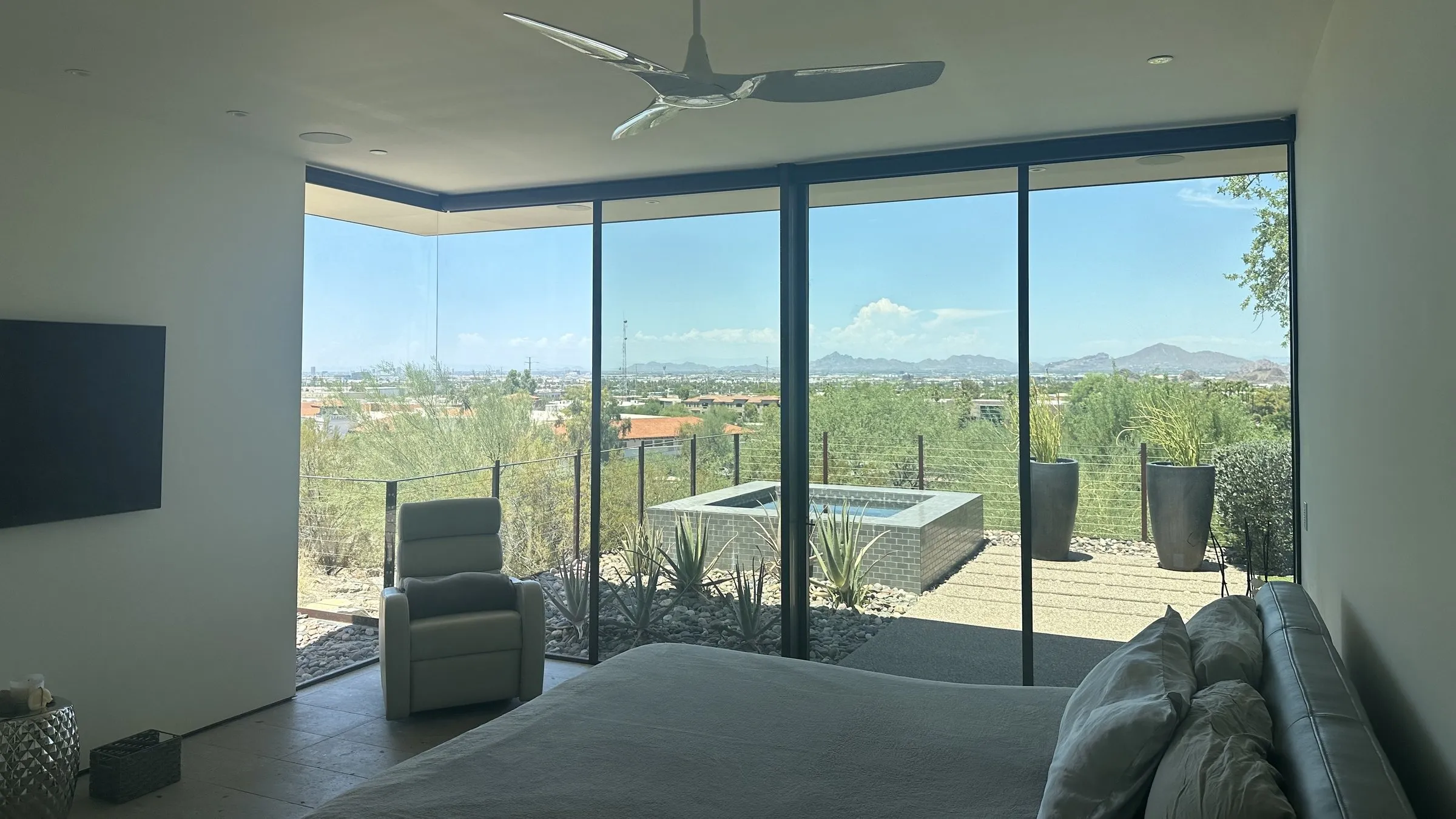
Home Window Tinting
Anti-Glare Window Film for Homes
Anti-glare window film for homes cuts the bright light that washes out screens and makes a glass-walled room hard to sit in. It works by reducing how much visible light comes through the glass. We install it for Arizona homeowners from $8.25 per square foot, with darker ceramic films from $11.50.
- From $8.25 per sq ft installed
- Samples on your own glass
- Limited Lifetime residential warranty
Overview
Glare reduction in a house built for light
Glare is a light problem more than a heat problem. It happens when a window lets in far more brightness than the rest of the room, so your eyes and your screens can’t adjust. Homes designed around views and daylight tend to have it in predictable places:
- West-facing great rooms in the late afternoon, when the sun sits low and runs straight across the floor.
- South-facing glass in winter, when the sun is lower and reaches deeper into the house.
- Sliders and pocket doors facing a pool, which bounce sunlight up through the opening.
- Clerestories and high windows that put a bright patch on a wall or screen at a certain hour.
- East-facing primary suites, where the first light arrives well before you want it.
Each calls for a slightly different film, and some only need treatment on one or two panes.
Part of our home window tinting services; also available as anti-glare window film for commercial buildings.
How it works
How anti-glare window film works
Anti-glare window film reduces the visible light that passes through the glass. Less light means less contrast between the window and the room, so a screen stays readable and a long table by the window becomes a comfortable place to sit again. Most anti-glare films are tinted or metallized solar films, so they also reject heat and block UV.
XPEL publishes a glare reduction figure for each film on 3 mm glass, which makes the range easy to see:
Clear View Plus 40
40% visible light, 53% glare reduction, 6% exterior reflectance.Evening View 25
26% visible light, 69% glare reduction.Evening View 15
15% visible light, 83% glare reduction.Evening View 5
8% visible light, 92% glare reduction.
Solar Gard publishes visible light figures on 6 mm clear glass rather than a glare figure. Panorama HiLite 55 keeps 56% of visible light and Panorama HiLite 40 keeps 40%, both with very low exterior reflectance, for glare control that leaves the facade almost unchanged. TrueVue 30, 15 and 5 step down from 31% to 5% visible light. Because the test glass differs, compare Solar Gard films with each other and XPEL films with each other, then look at samples on your own window.
Room by room
Anti-glare window film for homes, room by room
Home offices and studies
Video calls and monitors need even light. A moderate film usually takes the hot spot off the screen without making the room feel closed in. If the desk faces a view window, a darker film on that pane alone can help.
Home theaters and media rooms
This is where darker films belong. A film in the Evening View 15 or TrueVue 15 range cuts most of the glare from a west window, and shades handle the rest.
Kitchens and great rooms
People spend the whole day here, so most homeowners prefer a lighter, low-reflectance film that takes the edge off the harshest hours and keeps the room bright.
Primary suites
An east-facing bedroom can take a deeper film to soften early light, though film won’t black out a room the way a blackout shade does.
Pool and outdoor living glass
Reflected glare off the water is intense. A moderate film on the doors and windows that face the pool makes the view comfortable to look at in the afternoon, from inside and from a shaded patio looking back in.
Anti-glare film or anti-reflective coating?
They solve different problems. Anti-reflective coatings are used on lenses and screens to reduce reflections on the surface itself. Anti-glare window film reduces the light coming through the glass. If the problem is a bright window behind the screen or beside the desk, film on the window is what changes it.
Reflectance, HOA review and the view at night
Cutting glare means cutting light, so a darker film makes the room dimmer during the day. Most homeowners find the balance with one shade for the main living areas and a deeper one only where glare is worst.
Metallized films are also more reflective. From outside they can look mirrored in daylight, which matters to HOA design review and to anyone who chose the glass for its clarity, and from inside at night you may see your own reflection with the lights on. Low-reflectance films such as Clear View Plus or Panorama HiLite avoid most of that. We can provide product data for an architectural submission and leave samples for your designer or committee.
Many windows in Arizona homes are dual-pane or low-E, and some of those units limit which darker films can go on the inside. We check every window before recommending a shade.
Specs
Anti-glare window film specs
Solar Gard TrueVue
SRP rebate eligible| Film | Visible light transmitted | Total solar energy rejected | SHGC | UV blocked | Glare reduction |
|---|---|---|---|---|---|
| TrueVue 30 | 31% | 61% | 0.39 | >99% | n/a |
| TrueVue 15 | 12% | 77% | 0.23 | >99% | n/a |
| TrueVue 5 | 5% | 79% | 0.21 | >99% | n/a |
Manufacturer-published values measured on 1/4" (6 mm) clear glass; results on your windows vary by glass type. Sources: spec sheet
XPEL Evening View
SRP rebate eligible| Film | Visible light transmitted | Total solar energy rejected | SHGC | UV blocked | Glare reduction |
|---|---|---|---|---|---|
| Evening View 25 | 26% | 61% | 0.39 | 99% | 69% |
| Evening View 15 | 15% | 76% | 0.24 | 99% | 83% |
| Evening View 5 | 8% | 81% | 0.19 | 99% | 92% |
Manufacturer-published values measured on 1/8" (3 mm) glass; results on your windows vary by glass type. Sources: spec sheet
Finding the windows that cause glare
Glare is specific to time and place, so we plan around when it actually bothers you. Before the visit, think about the hour it is worst and where you are sitting when it happens. A study that glares late in the afternoon needs a different answer than a great room that is only uncomfortable for part of the winter.
At the visit we walk each room with you, note which panes throw light onto a screen or into your eyes, and check the glass type of each one. Then we hold samples of two or three shades against those panes. Seeing a film on your own window, in your own light, is far more useful than any spec sheet, and it is usually where homeowners decide that one room needs a deeper film than the rest.
The written proposal lists each window with its film and square footage. You can treat only the worst panes now and add others later, and we keep a record of what was installed so a later visit matches the first.
Anti-glare film installation and care
On install day the crew covers floors and sills and moves or wraps furniture and equipment near the glass, including screens and speakers in a media room. Each pane is cleaned, filmed and trimmed to the frame. Small water pockets or a light haze can show for a while as the film cures; that is normal and clears on its own. Solar Gard’s care guidance is to wait 30 days before cleaning, then use mild dish soap and water on a soft cloth, and keep razor blades and scouring pads away from the filmed side. If a window cleaning service looks after the house, pass the care instructions along.
Cost
Anti-glare film cost and SRP rebates
Solar control films used for glare start from $8.25 per square foot, and darker ceramic films start from $11.50. Removal of old film adds $4.50 per square foot, and upper-floor or lift access adds 15%. Several anti-glare films we install, including XPEL Evening View 25, 15 and 5 and Solar Gard TrueVue 30, 15 and 5, qualify for the SRP window film rebate on east-, south- and west-facing windows of an air-conditioned home. SRP is the only Arizona utility with a window film rebate, and current amounts are published at savewithsrp.com. On a home, XPEL Evening View, XPEL Clear View and Solar Gard TrueVue carry a Limited Lifetime residential warranty when an authorized dealer installs them.
If heat is as much of a problem as glare, read our solar window film page. If you also want people outside to stop seeing in, see privacy window film. For more reading, see our article on anti-glare security film. The home window tinting page shows everything we install for homes, and offices and schools should see commercial anti-glare window film.
Anti-glare window film cost per square foot
Installed prices start at $8.25 per square foot. Your written proposal is based on measured glass, film choice and access.
| Film grade | Installed price per sq ft |
|---|---|
| Darker ceramic | From $11.50 |
| Solar control | From $8.25 |
Prices as of October 2026, from our bid-tool customer rates. Old film removal adds $4.50 per sq ft; upper-floor or lift access adds 15%.
Related films
More home window tinting films
Guides
Anti-glare window film guides
Does anti-glare window film work?
Yes, because it reduces the visible light coming through the glass. XPEL publishes glare reduction of 50% to 92% across its Evening View line on 3 mm glass, depending on how dark the film is.
What is the best window film for reducing sun glare?
The right film depends on how bright the window is and how much daylight you want to keep. Lighter films suit kitchens and great rooms, and darker films such as XPEL Evening View 15 or Solar Gard TrueVue 15 suit theaters and west-facing rooms.
Which is better, anti-reflective or anti-glare?
For a bright window, anti-glare film on the glass. Anti-reflective coatings reduce reflections on a lens or screen surface, while window film reduces the light that causes the glare in the first place.
Will anti-glare film make my house look mirrored?
Some metallized films look reflective from outside in daylight. Low-reflectance options such as XPEL Clear View Plus 40, published at 6% exterior reflectance and 53% glare reduction on 3 mm glass, look much closer to ordinary glass.
Can I put anti-glare film on only one window?
Yes. Many homeowners treat just the glass behind the screen or beside the desk. We'll recommend a shade that looks consistent with the rest of the house from outside.
Does anti-glare film help with screens in a home office?
Yes. By lowering the brightness of the window, it reduces the contrast that washes out a monitor and makes video calls easier to light evenly.
Is window film enough to darken a home theater with windows?
Film cuts glare sharply but does not black out a room. XPEL publishes Evening View 5 at 8% visible light and 92% glare reduction on 3 mm glass; for full darkness during a film, pair it with motorized or blackout shades.
Free consultation
Book a free window tinting consultation
Tell us about your glass and we'll send a written proposal.
(480) 977-6994- Arizona: ROC Lic# 333727
Licensed, factory-authorized window film installers
- Arizona: ROC Lic# 333727
- Solar Gard / Saint-Gobain authorized dealer
- Armorcoat authorized installer
- XPEL authorized dealer
- Madico SafetyShield qualified dealer
- Full XPEL VISION line installed
- 25 years of window film experience
Because we're factory-authorized, film is installed to manufacturer spec and carries the manufacturer's warranty.