
Commercial window film by industry
Restaurant Window Tinting and Hotel Window Film
We install restaurant window tinting and hotel window film across the Phoenix and Tucson metros. Solar and anti-glare films cool west-facing dining rooms and cut sunset glare, UV films slow fading on booths and lobby furniture, and frosted or decorative films add privacy, with installs scheduled around service hours and occupied rooms.
Overview
Restaurant window tinting for Arizona dining rooms
Restaurants in Arizona sell the view and the light as much as the food. Wide front glass makes a dining room look open from the street, and patio doors connect the room to outdoor seating. The same glass lets in the afternoon sun. Tables along the window get too hot to seat, servers pull the shades just as the room fills, and upholstery and floors fade where the light lands.
Restaurant window tinting fixes that at the glass. A film is applied to the existing windows, usually on the inside face, and it rejects a share of the sun’s heat, cuts glare and blocks ultraviolet light before it reaches the room. The windows stay in place and the room keeps its daylight. It is part of the commercial window tinting work we do for owners, operators and property managers across the Phoenix and Tucson metros.
Part of our commercial window tinting services. See every industry we serve.
Sunset glare in west-facing dining rooms
The hardest glass in most restaurants faces west. In Phoenix, Sky Harbor averages about 111 days a year at 100°F or hotter, and Tucson International Airport about 68 (NOAA 1991 to 2020 normals). Dinner service starts while the sun is still low and straight in the window, so the glare peaks right when the room is busiest. Guests squint, booths along the glass sit empty, and the air conditioning works hardest against the warmest part of the room.
Patio doors and bar seating along the glass
Patio doors and bar-height counters along a window are the usual problem spots, because people sit close to the glass and face it. For those openings we look at darker anti-glare window film, which cuts more visible light. XPEL publishes Dark Neutral 15 at 12% visible light and 70% of total solar energy rejected on 3 mm glass. Where the owner wants the glass to stay close to clear, a lighter commercial solar window film is the better fit: Solar Gard publishes Panorama HiLite 40 at 40% visible light and 61% total solar energy rejected on 6 mm clear glass.
Restaurant window film, matched to the problem
A dining room rarely has just one glass problem, so we match film to each one rather than putting the darkest film everywhere.
Heat and glare
Solar control and ceramic films on the sun side, with lighter films on shaded elevations.Fading
Booth fabric, wood tables, artwork and floors fade under sun. The solar films we install are published at 99% or more UV blocked. Our UV protection window film page covers films that block UV while staying nearly clear, and Solar Gard publishes TrueVue 30 at a 72% reduction in fading on 6 mm clear glass.Front glass after closing
A restaurant’s front windows sit dark and unattended overnight. Clear security window film holds broken glass together so a break-in takes more time and effort. It does not make glass unbreakable.
Hotel lobby and guest room glass
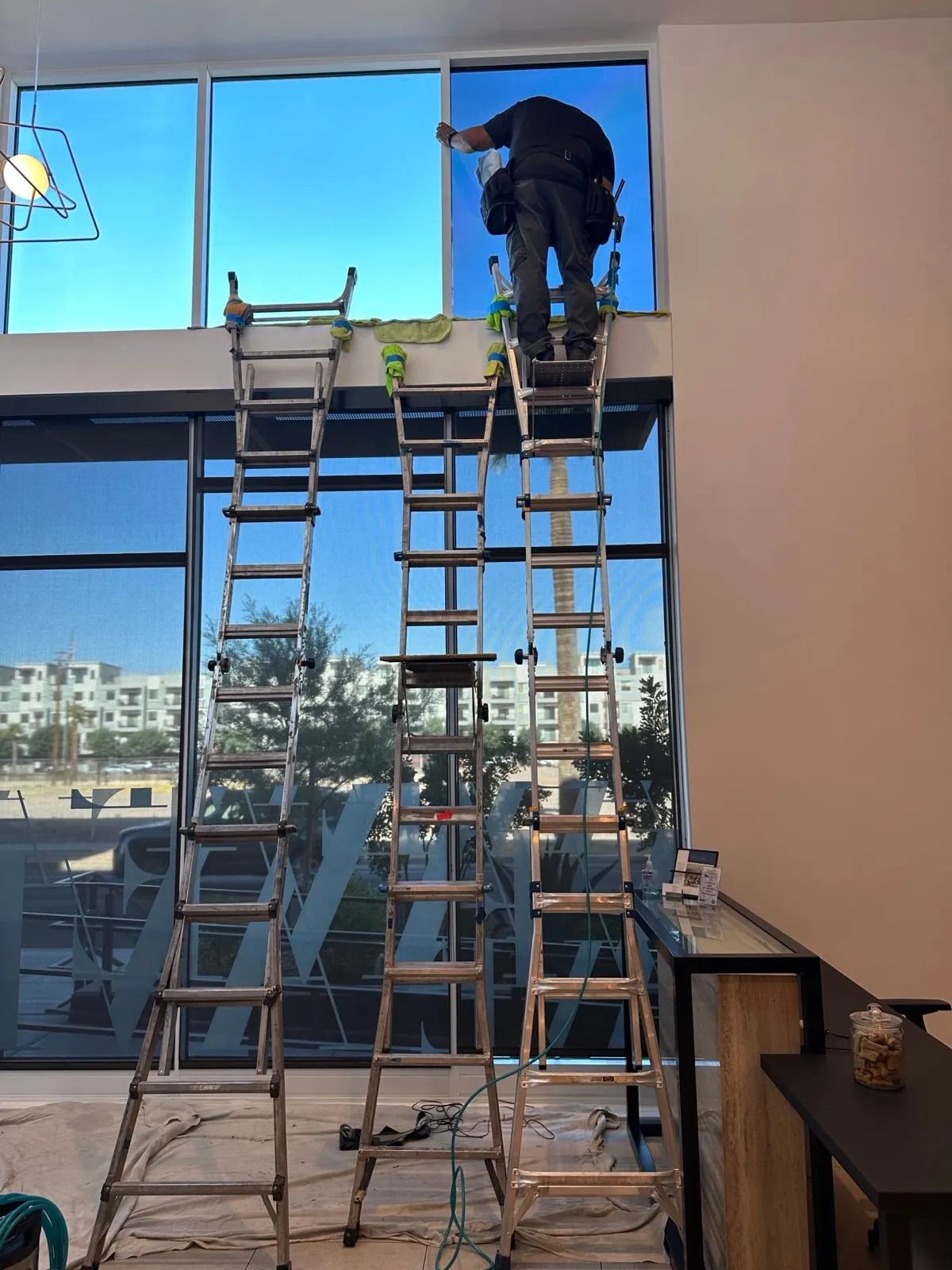
Hotels have the same sun on a bigger scale, plus rooms that are occupied around the clock. Lobbies are often two stories of glass at the entrance, and the front desk and lounge seating take the glare. In guest rooms, the complaints are heat at the window in the afternoon, glare on the television and fading on carpet, drapes and furniture. Film on lobby and guest room glass addresses all three without changing the windows. Clients we have worked for include Renaissance Hotels.
Hotels also have glass that needs privacy rather than sun control: fitness rooms, spa and treatment rooms, meeting rooms off the lobby, and back-of-house areas behind glass. For a reflective one-way look, keep in mind that the effect depends on which side of the glass is brighter, so it works in daytime and reverses at night when the room is lit. Our commercial privacy window film page explains the difference.
Decorative and privacy film for dining rooms and hotels
Decorative window film gives glass an etched or frosted finish without replacing it. Restaurants use it on glass partitions between the bar and dining room, on private dining rooms, on restroom windows and on the lower part of street glass so diners are not on display at eye level. Hotels use it in conference rooms, fitness centers and spa areas. Films we install include XPEL Dusted Crystal, XPEL White Frost and Madico Frost Matte, and a band or shape can be cut into the film to carry a pattern or a logo. Decorative films come off cleanly, which matters when a concept changes or a lease ends.
Storefront graphics for restaurants and hotel entries
Window glass is also signage. Logos, hours, menu panels and seasonal promotions can go on the glass as printed graphics, and lobby walls can carry a large printed mural. Our print partner produces the graphics to the sizes we measure on site, and our crews prepare the glass and walls and install them. The custom graphics and wall murals page covers how artwork and sizing work. Before ordering exterior graphics, check your city’s sign rules and your landlord’s requirements.
Restaurants and hotels in Phoenix and Tucson
In the Phoenix metro, restaurants line the arterials such as Camelback Road, Indian School Road and Bell Road, where storefront glass faces the parking lot and often the afternoon sun. Our Phoenix commercial window tinting page covers the city’s building types in more detail.
In Tucson, the blocks around the University of Arizona are full of restaurants and shops with wide street-facing windows, and Oracle Road, Speedway, Broadway and Grant carry strip centers with restaurant pads. Downtown has older masonry buildings next to newer construction. See our Tucson commercial window tinting page for how we work there.
How a restaurant or hotel film project runs
- STEP 1
Site visit
We measure the glass, note which way each elevation faces, check the glass type and look at how the room is used through the day. - STEP 2
Samples on the glass
We bring film samples so the owner or designer can see the color and darkness on the real windows. - STEP 3
Written proposal
It lists the film for each opening, the manufacturer’s published data, the warranty that applies and the schedule. - STEP 4
Installation around service
Restaurants are usually done before opening, between services or after close. Hotels are done room by room or floor by floor as rooms are released, with lobbies done when traffic is light. - STEP 5
Care handoff
New film should not be cleaned for 30 days. After that, mild soap and water or a commercial glass cleaner with soft cloths is the rule, and we leave written care instructions for the cleaning crew.
Cost
What restaurant and hotel film costs
Film is priced per square foot of glass, and every restaurant and hotel is quoted after a site visit. Film choice, the size and number of panes, access above the ground floor and any old film that has to be removed set the total. The price table below shows our current per square foot rates. Manufacturer warranties vary by film; Solar Gard’s commercial warranty on TrueVue is 12 years, and XPEL covers its Clear View Ceramic films for 15 years on commercial glass. Recent jobs are in our project gallery, and our article on storefront window tint covers more of the benefits for street-facing businesses.
Window film cost for restaurants and hotels
Installed prices start at $8.25 per square foot. Your written proposal is based on measured glass, film choice and access.
| Film grade | Installed price per sq ft |
|---|---|
| Clear ceramic | From $9.00 |
| Darker ceramic | From $11.50 |
| Solar control | From $8.25 |
| Privacy frost | From $8.25 |
Prices as of October 2026, from our bid-tool customer rates. Old film removal adds $4.50 per sq ft; upper-floor or lift access adds 15%.
Trusted on projects for


Industries
Window film for other industries
Guides
Commercial window film guides
Service areas
Commercial window tinting in Phoenix, Tucson and nearby
Common questions
Questions about window film for restaurants and hotels
Have a question about your glass? Ask us.
Will restaurant window tinting make the dining room look dark from the street at night?
Every film reduces some visible light, but lighter ceramic and spectrally selective films keep the glass close to clear. XPEL publishes Clear View Ceramic 60 at 61% visible light on 3 mm glass. After dark the lit dining room is brighter than the street, so diners stay visible from outside with most films.
Can a restaurant patio door or bar window get a different film from the rest of the dining room?
Yes. We often put a darker anti-glare film on the west or south glass that takes direct late sun and a lighter film on shaded glass. We pick films from one family where we can so the colors stay close when you look along the frontage.
How do you install film in a restaurant without closing for service?
Most restaurant installs run before opening, between lunch and dinner, or after close. We cover tables and booths near the glass, work one section at a time, and leave the dining room clean. The written proposal lists the schedule so the manager can plan staffing around it.
Can hotel guest rooms be filmed while the hotel stays open?
Yes. We work room by room or floor by floor in the order the hotel's operations team releases them, so occupied rooms are not disturbed. Lobbies and public areas are usually done early in the morning or overnight when traffic is light.
Which film gives privacy to a hotel fitness room or pool-facing glass without blocking light?
Frosted and decorative films diffuse the view day and night while still passing daylight. XPEL White Frost and Madico Frost Matte are two we install. A frosted band at eye height keeps the upper glass clear for daylight and views.
Do you print the logos and menu graphics for restaurant windows?
No. A print partner produces the graphics to the sizes we measure, and our crews prepare the glass and install them. You or your designer supply the artwork, and we coordinate the print order so you deal with one company.
How is restaurant window tinting priced?
Film is priced per square foot of glass, and each restaurant or hotel is quoted after a site visit. Film choice, glass size, ladder or lift access and any old film that has to come off set the total. The price table on this page shows the current per square foot rates.
Free consultation
Book a free window tinting consultation
Tell us about your glass and we'll send a written proposal.
(480) 977-6994- Arizona: ROC Lic# 333727
Licensed, factory-authorized window film installers
- Arizona: ROC Lic# 333727
- Solar Gard / Saint-Gobain authorized dealer
- Armorcoat authorized installer
- XPEL authorized dealer
- Madico SafetyShield qualified dealer
- Full XPEL VISION line installed
- 25 years of window film experience
Because we're factory-authorized, film is installed to manufacturer spec and carries the manufacturer's warranty.