
Commercial window film by industry
Industrial Window Film for Warehouses and Plants
We install industrial window film on warehouses, distribution centers and plants across the Phoenix and Tucson metros. Heat control film cools glass front offices, blackout film hides storage and production areas, security film protects entries, and one-way film gives guard booths a clear view out, all quoted after a site visit.
Overview
Industrial window film for Arizona warehouses
Most warehouses and plants in Arizona have less glass than an office building, but the glass they have works hard. A typical building has a glass office front, a lobby or showroom, a few clerestory or high windows in the warehouse, and glass doors at the main entrance. The office is conditioned and occupied all day. The space behind it often is not. That mix decides where film earns its place.
Industrial window film covers several jobs on these buildings: cutting heat and glare in the front office, turning clear glass opaque where storage or production areas should not be seen, holding entry glass together, and giving security staff a view out without being seen. It is part of our commercial window tinting work for owners, facilities managers, tenants and general contractors in the Phoenix and Tucson metros. Our clients include Amazon and Li-Cycle.
Part of our commercial window tinting services. See every industry we serve.
Heat control window film for the front office
The front office is where most heat complaints start. Many industrial buildings face their offices toward the street or the parking lot, and when that elevation faces west or south, desks along the glass bake every afternoon. Phoenix Sky Harbor averages about 111 days a year at 100°F or hotter, and Tucson International Airport about 68 (NOAA 1991 to 2020 normals). Film on the front office glass is often the most cost-effective comfort fix in the building.
Heat control window film rejects a share of the sun’s energy at the glass. The choice depends on how much daylight the office needs and how the building should look from outside:
- Reflective and darker films reject the most heat. Solar Gard publishes TrueVue 15 at 12% visible light and 77% of total solar energy rejected on 6 mm clear glass, and XPEL publishes Silver 15 at 17% visible light and 78% rejected on 3 mm glass.
- Lighter films keep the office brighter. Solar Gard publishes Panorama HiLite 40 at 40% visible light and 61% rejected on 6 mm clear glass.
Values come from each maker on different test glass, so compare within a brand. Our commercial solar window film page explains how to weigh visible light against heat rejection, and the article on solar heat gain coefficient covers the numbers behind it.
Skylights are a different question
Solar Gard’s commercial warranty lists skylight glass among its exclusions, so film on a skylight would not carry that coverage. Our recommendations focus on vertical glass, where the warranty and the published performance data apply. If skylights are part of the heat problem, we look at them during the site visit and say in the proposal what can and cannot be covered.
Blackout film for windows in storage and production areas
Some industrial glass should not be seen through at all. Inventory, production lines, equipment rooms and staging areas behind windows tell people outside more than an owner wants. Blackout and spandrel window film turns clear glass into solid black or white panels. XPEL publishes Black Out at 0% visible light transmitted and White Out at 9%, both on 3 mm glass.
Blackout film also solves light problems inside. Rooms that need real darkness during the day, such as labs, inspection rooms or rooms with screens, can be blacked out at the glass.
Opaque film comes with a heat caution. XPEL lists Black Out as absorbing 95% of the solar energy that hits it, and most of that turns into heat in the pane. On annealed glass facing west or south, that heat can stress the glass. We check the glass type against the film maker’s film-to-glass guidance first, and where black film is risky we propose White Out, which absorbs about a third as much solar energy, or a dense privacy window film.
Security film and one-way film at the gate
Security window film for entries and offices
Glass entry doors, sidelites and ground-floor office windows are the easiest way into most industrial buildings after hours. Clear security window film is bonded to the glass so that a broken pane holds together as a sheet, which slows forced entry and keeps shards off the floor. We install Solar Gard Armorcoat and XPEL Security Clear films in thicknesses from 4 to 14 mil, and filmed glass can be anchored to the frame. It does not make glass unbreakable. Our article on commercial window security films covers how businesses plan it.
One-way window film at guard booths
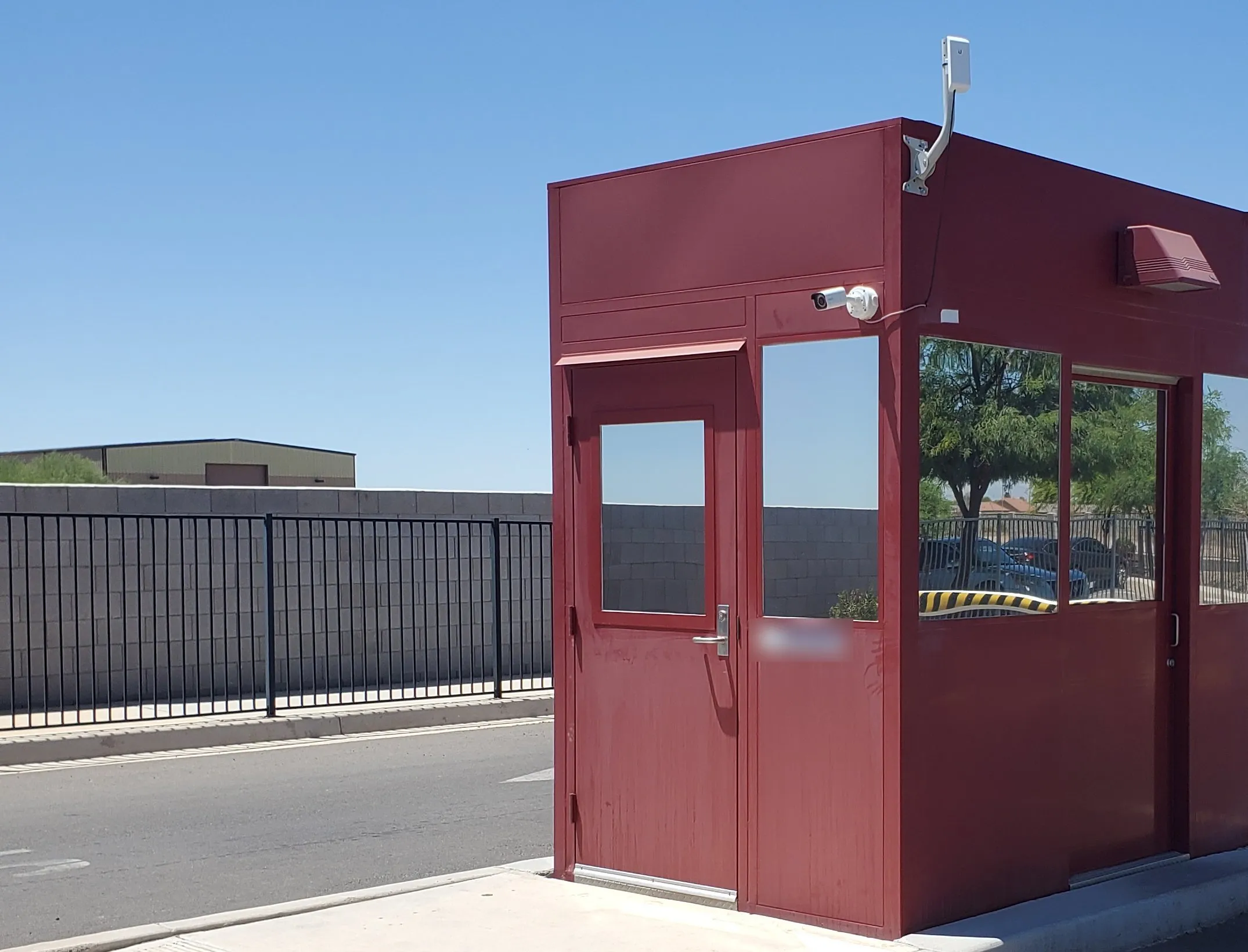
In 2022 we installed one-way window film on the guard booth at an industrial plant entrance in Casa Grande. Guards see the gate and the approach road, and in daylight people outside see a mirror. One-way film works by brightness: it shows a mirror to the brighter side, so at night, with the booth lit, the effect reverses. For booths staffed after dark, we talk through interior lighting before choosing a film. The job is in our project gallery.
Exterior building wraps for industrial buildings
Industrial exteriors take the full Arizona sun, and metal panels, door frames and signage areas fade and chalk over time. Exterior building wraps include architectural finish films that reface faded doors, columns and panels, opaque film that matches mismatched glass, and printed wraps for brand walls or leasing graphics on a vacant building. Outdoor-rated materials are used for all exterior work, and XPEL warrants its exterior films for 5 years on the film and 2 years on labor. Printed graphics are produced by our print partner and installed by our crews.
Industrial buildings in Phoenix and Tucson
In the Phoenix metro, warehouses near Sky Harbor and along the I-10 and I-17 usually have a glass office front with a lot of unconditioned space behind it. Our Phoenix commercial window tinting page covers those buildings alongside offices and retail.
In Tucson, the I-10 corridor has warehouses, flex space and light industrial buildings with offices up front. See our Tucson commercial window tinting page for how we schedule work there.
How a warehouse or plant project runs
- STEP 1
Site visit
We walk the building with the facilities lead, measure the glass, note each elevation’s exposure and identify the glass type in every opening. - STEP 2
Film and glass check
Each film is matched to the glass using the manufacturer’s guidance, which matters most for blackout and dark films on sunny elevations. - STEP 3
Written proposal
It lists film by opening, published data, the manufacturer warranty, access equipment and the schedule. Solar Gard needs prior written approval for jobs over 2,500 square feet and XPEL over 3,000, and we request it before we start. - STEP 4
Installation around operations
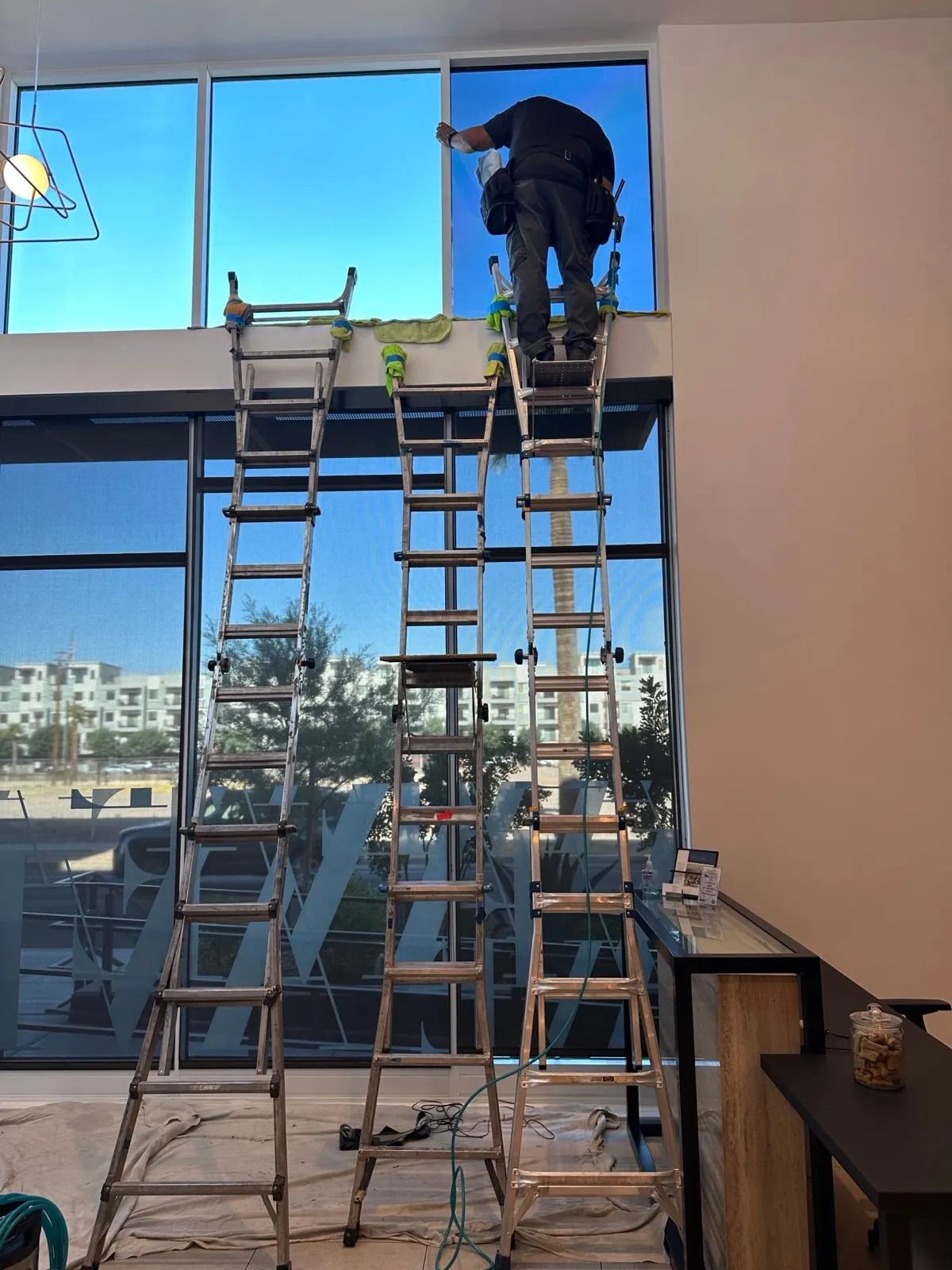
We work around shifts and follow the site’s contractor safety rules. High glass is reached by ladder or lift. - STEP 5
Care handoff
No cleaning for 30 days, then mild soap and water or a commercial glass cleaner with soft cloths.
Cost
Warehouse window film cost
Industrial window film is priced per square foot and quoted per project after a site visit. Film choice, glass size, lift access above the ground floor and any old film to remove set the total. The price table below shows our per square foot rates; blackout film and exterior wraps are quoted per project.
Window film cost for industrial and warehouse buildings
Installed prices start at $8.25 per square foot. Your written proposal is based on measured glass, film choice and access.
| Film grade | Installed price per sq ft |
|---|---|
| Clear ceramic | From $9.00 |
| Darker ceramic | From $11.50 |
| Solar control | From $8.25 |
| Security | From $9.50 |
| Privacy frost | From $8.25 |
Prices as of October 2026, from our bid-tool customer rates. Old film removal adds $4.50 per sq ft; upper-floor or lift access adds 15%.
Window film projects for industrial and warehouse buildings
One-way window film in Casa Grande, AZ
Security checkpoint one-way film
Casa Grande, AZ · One-Way Window Film ·
One-way film on the guard booth at an industrial plant entrance: guards see the gate and approach road, and in daylight drivers see a mirror.
Trusted on projects for


Industries
Window film for other industries
Guides
Commercial window film guides
Service areas
Commercial window tinting in Phoenix, Tucson and nearby
Common questions
Questions about window film for industrial and warehouse buildings
Have a question about your glass? Ask us.
Is industrial window film worth it on a warehouse that is mostly unconditioned?
Usually the payoff is in the conditioned parts: the front office, break rooms, shipping offices and any glass that faces west or south. Those spaces are where people sit next to the glass and where heat and glare cause complaints. We survey the building and propose film only where it does a job.
Can blackout film go on warehouse windows that face full sun?
Sometimes, but it needs a glass check first. Opaque film absorbs most of the sun that hits it and heats the pane, and annealed glass on a sunny elevation is the riskiest case. XPEL White Out absorbs far less solar energy than black film, so it is often the safer choice on hot elevations.
How does one-way film on an industrial guard booth work?
Reflective film shows a mirror to whoever is on the brighter side of the glass. In daylight the outside is brighter, so guards inside can see the gate and approach road while people outside see a mirror. At night, with the booth lit, the effect reverses unless lighting is planned around it.
Do you put film on warehouse skylights?
Skylights need their own look. Solar Gard's commercial warranty lists skylight glass among its exclusions, so film on a skylight would not carry that coverage. We check skylights during the site visit and say in the proposal what can and cannot be covered.
Can film be installed in a distribution center or plant without stopping operations?
Yes. Film work is quiet and needs only access to the glass and a little floor space. We schedule around shifts, work one area at a time, and follow the site's safety and check-in rules for contractors.
What warranty paperwork do large industrial window film jobs need?
Solar Gard requires prior written approval for installs over 2,500 square feet, and XPEL for projects over 3,000 square feet. We request that approval before the install so the manufacturer warranty is in place, and we supply spec sheets and warranty documents for your files.
Free consultation
Book a free window tinting consultation
Tell us about your glass and we'll send a written proposal.
(480) 977-6994- Arizona: ROC Lic# 333727
Licensed, factory-authorized window film installers
- Arizona: ROC Lic# 333727
- Solar Gard / Saint-Gobain authorized dealer
- Armorcoat authorized installer
- XPEL authorized dealer
- Madico SafetyShield qualified dealer
- Full XPEL VISION line installed
- 25 years of window film experience
Because we're factory-authorized, film is installed to manufacturer spec and carries the manufacturer's warranty.